As connected vehicles, clean energy and large language models weave deeper into daily life, a pressing question takes center stage: how does society strike a balance between innovation and efficiency on one hand, and safety, ethics and accountability on the other?
At the Zhejiang University–University of Illinois Urbana-Champaign Institute (ZJUI), this question is explored through Engineering Ethics, a graduate course taught by ZJUI Assistant Professor Lin Fanfan. The course is offered to master’s students at ZJUI as well as students in the International Master of Data Science program at the International Business School, Zhejiang University (ZIBS). Building on the existing course framework, Assistant Professor Lin has introduced new approaches to both course content and teaching, combining theoretical instruction with case studies and themed debates.
This semester, the course featured 11 debates spanning topics from smart transportation and next-generation computing to energy transition, data privacy and public safety. Students delved into real-world cases, built evidence-based arguments, and evaluated technologies through multiple lenses like technical feasibility, personal privacy, public safety, long-term sustainability and the broader public good.
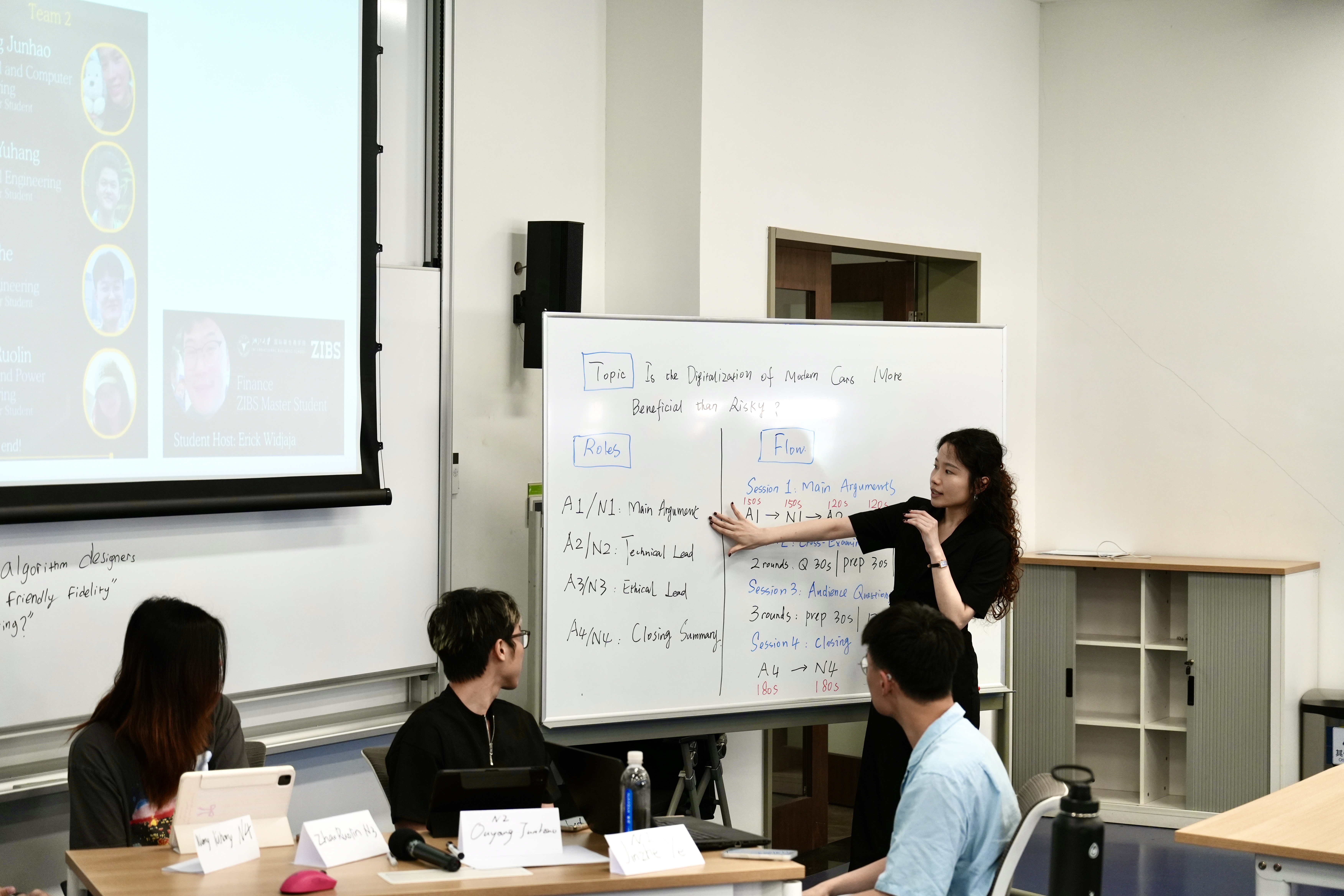
The semester culminated in a final debate on whether automotive digitalization delivers more benefits than harm. As sensors, smart algorithms and cloud computing become deeply embedded in modern vehicles, cars are rapidly evolving into “computers on wheels.” While these technologies unlock unprecedented convenience and efficiency, they also spark legitimate concerns over cybersecurity vulnerabilities, data privacy risks, algorithmic errors and ambiguous liability.
Eight first-year master’s students across diverse programs made up the affirmative and opposing teams. Assistant Professor Lin served as faculty moderator, with Erick Widjaja, a 2025 master’s student in Finance at International Bussiness School, Zhejiang University (ZIBS), acting as student chair.
The affirmative side framed automotive digitalization as an irreversible industry trend, arguing that it boosts travel efficiency, elevates the in-car experience, and cuts accidents caused by human error. They contended that privacy and security risks can be effectively mitigated through ongoing technological advancement, stricter regulatory oversight and refined industry standards.
The opposing side underscored the dangers of software glitches, remote control vulnerabilities and pervasive data collection. When technologies directly impact human safety, they stressed, engineers and manufacturers must treat safety as a non-negotiable, top-priority responsibility.
Ultimately, the debate moved far beyond a simplistic tally of pros and cons. It prompted deeper reflection on the principles that should guide society as technologies enter daily life before reaching full maturity.
Following an audience vote, the affirmative team was named the winner, recognized for its clear line of reasoning, robust supporting evidence and sharp rebuttals.
Through courses like Engineering Ethics, ZJUI strives to nurture future engineers capable of striking a thoughtful balance between innovation and safety, efficiency and equity, ensuring technological progress always remains people-centered and grounded in social responsibility.