In a recent breakthrough in the study of heat transport in ultrathin polymer crystals, a team led by Associate Professor Wee-Liat Ong at Zhejiang University–University of Illinois Urbana-Champaign Institute (ZJUI) has published new findings in Advanced Materials. The paper's first authors include Yu Taocheng, a 2021 doctoral student in Power Engineering and Engineering Thermophysics; Tu Jing, a 2019 doctoral graduate in the same field; and the corresponding authors are Associate Professor Wee-Liat Ong of ZJUI and Professor Li Hanying of the Department of Polymer Science and Engineering, Zhejiang University. Other co-authors include Yang Jin, a 2020 doctoral graduate in Power Engineering and Engineering Thermophysics, among others.
▲
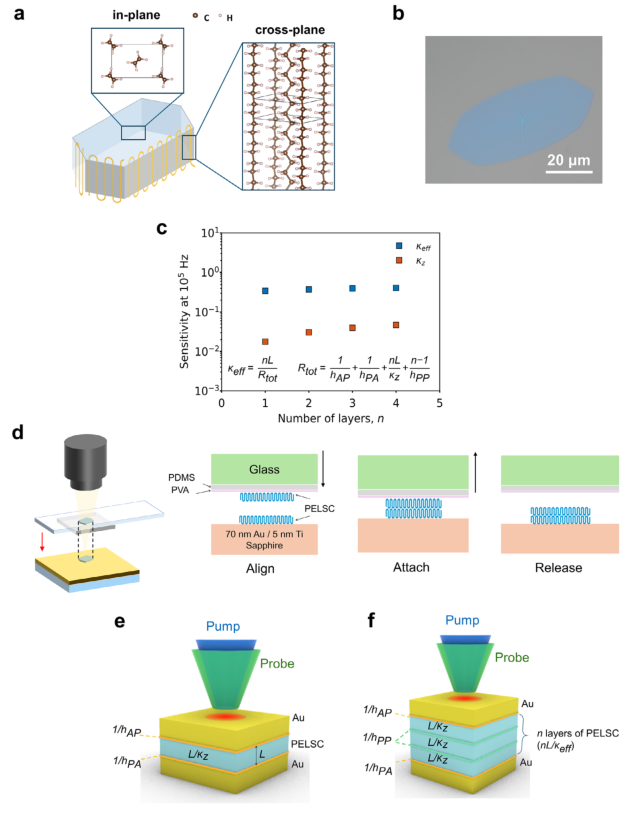
Accurately measuring heat transport in single-layer ultrathin polymer crystals has long been difficult because of their extreme thinness and fragility. To overcome this challenge, the team developed a PDMS-assisted dry-transfer method that enables the nondestructive stacking of polyethylene lamellae, significantly improving measurement sensitivity.
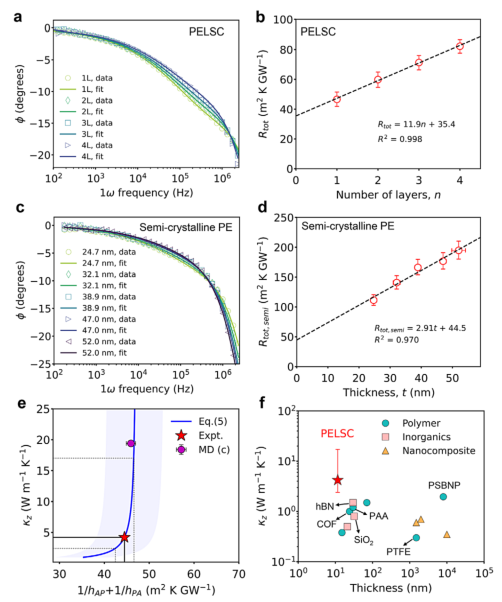
Experiments showed that thermal resistance increased nearly linearly with the number of layers, with an R² of 0.998. Based on this relationship, the researchers determined that the cross-plane thermal conductivity of the polyethylene lamellae reached 4 W/m·K, surpassing many nanoscale dielectric materials and highlighting the promise of polymer crystals for combining electrical insulation with heat dissipation.
▲
Theoretical analysis further showed that while ideal bulk polyethylene crystals could achieve much higher thermal conductivity, performance drops sharply at ultrathin dimensions because boundary scattering begins to dominate heat transport. Additional modeling found that amorphous surface layers and structural disorder further suppress thermal conduction in real materials.
The study provides the first experimental evidence that ultrathin polymer crystals can achieve relatively high thermal conductivity, while also clarifying the key roles of boundary scattering and surface disorder in nanoscale heat transport. The findings offer new insights for the design of thermally conductive, electrically insulating polymer materials for applications including microelectronics cooling, flexible electronics, thermal interface materials, and advanced packaging.