Recently, a research team led by Assist. Prof. Hou Qingchun at ZJUI has achieved new advances in the area of linear constraint satisfaction in neural networks. The related findings have been published at AAAI Conference.
▲
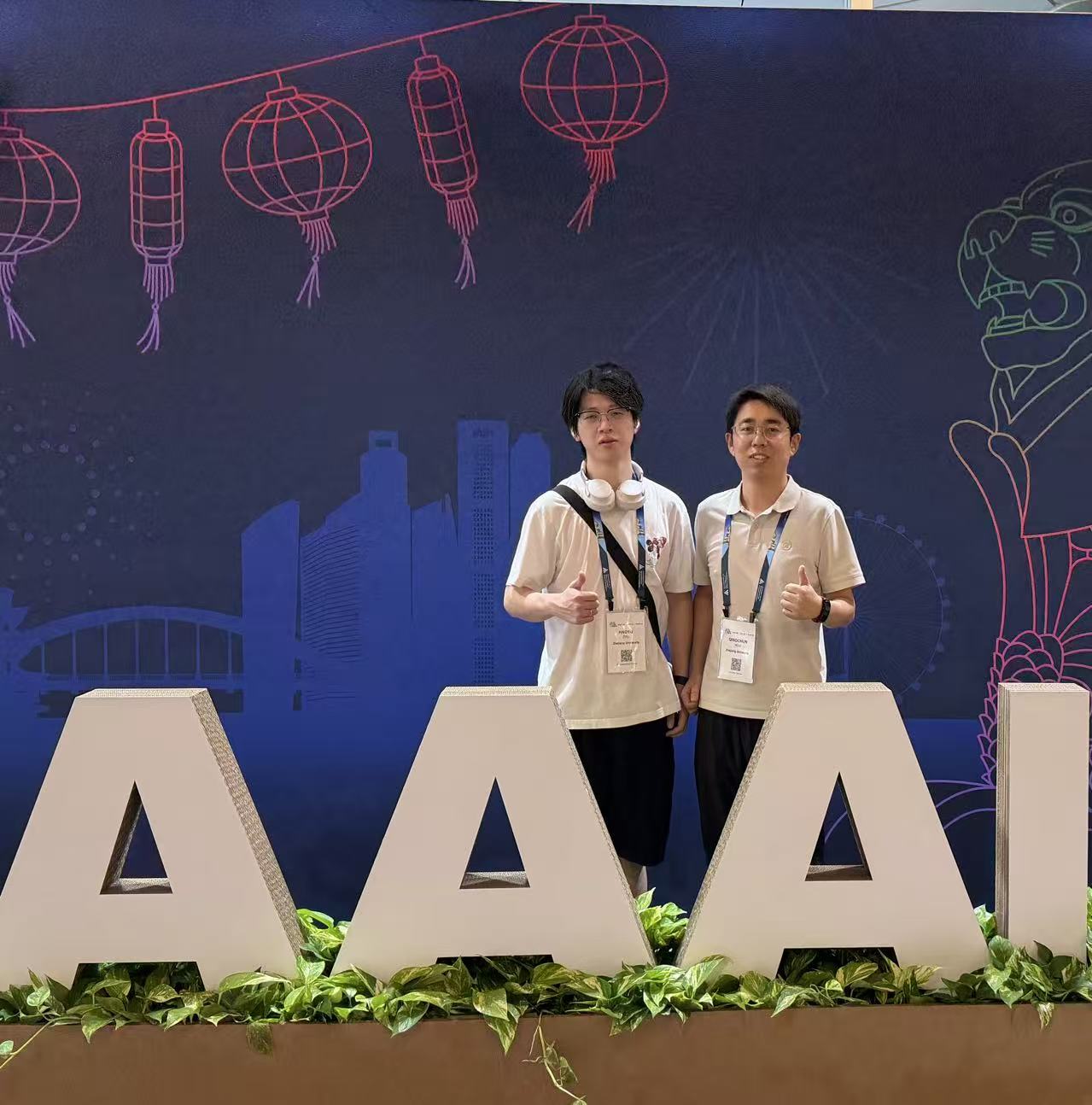
The paper is authored by Zhu Haoyu, class of 2026 in Electrical Engineering at ZJUI, as the first author, with Assist. Prof. Hou Qingchun serving as the corresponding author. Additional contributors include Zhang Yao, a 2022 doctoral student in Electrical Engineering, and Ren Jiashen, class of 2026 in Electrical Engineering at ZJUI.
▲
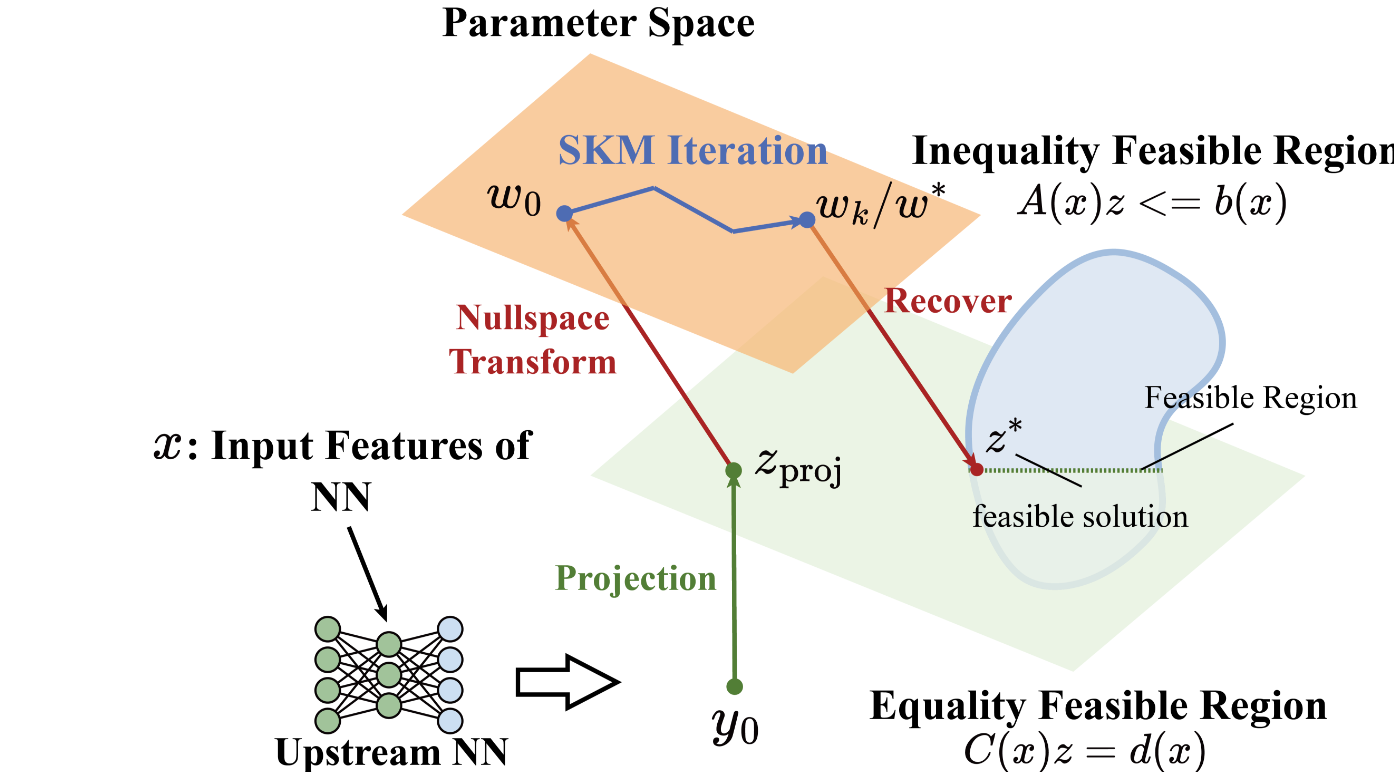
This paper proposes T-SKM-Net, a trainable framework designed to achieve strict satisfaction of linear constraints. It leverages an SVD-based null-space transformation to address mixed equality-inequality constraints within a subspace where equality constraints are inherently satisfied. Subsequently, it performs efficient Sampling Kaczmarz–Motzkin iterations by projecting onto the most severely violated constraint selected from a small random sample, before finally mapping the derived solution back to the original variable space.
A core theoretical contribution of this work lies in the establishment of rigorous approximation guarantees. Specifically, the paper proves that the proposed iterative process can approximate the true L₂ projection in expectation. Moreover, despite the non-differentiable nature of the constraint selection step, the work further develops an end-to-end training pipeline enabled by unbiased gradient estimation.
Experimental evaluations on the IEEE 118-bus DCOPF benchmark demonstrate the superior performance of T-SKM-Net. In post-processing mode, it achieves a serial GPU inference speed of 4.27 ms per item; in joint training mode, the inference speed is 5.25 ms per item. Notably, the framework yields zero constraint violations within the predefined tolerance, while delivering over 25× speedup compared with the pandapower solver.
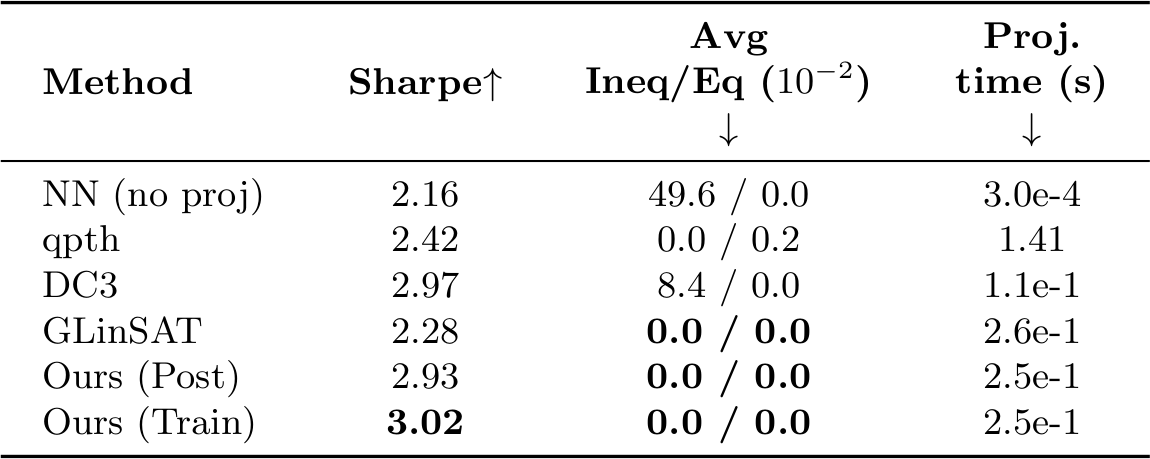
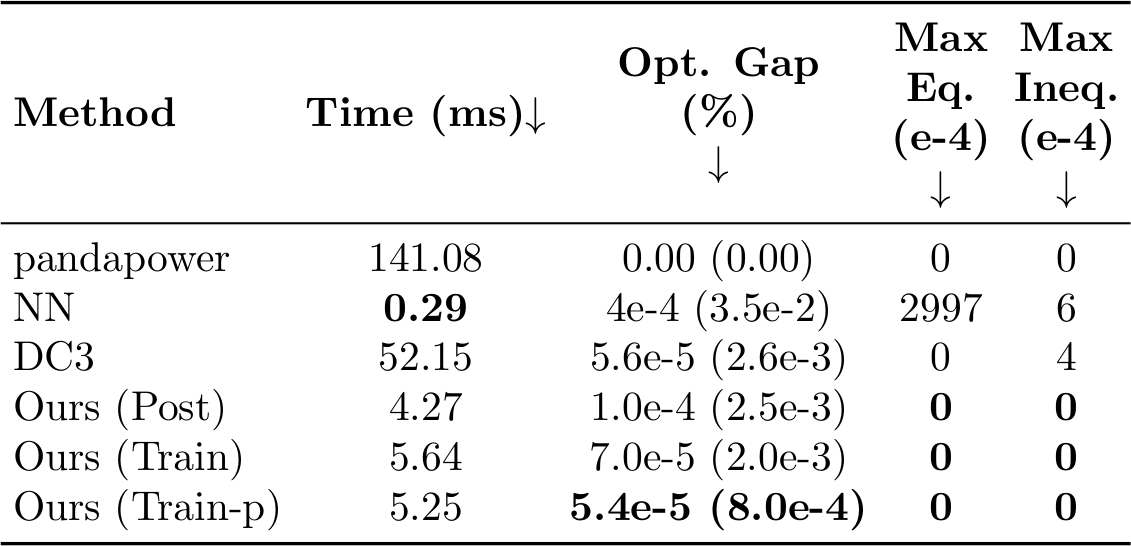
▲DCOPF(IEEE 118-bus)性能对比
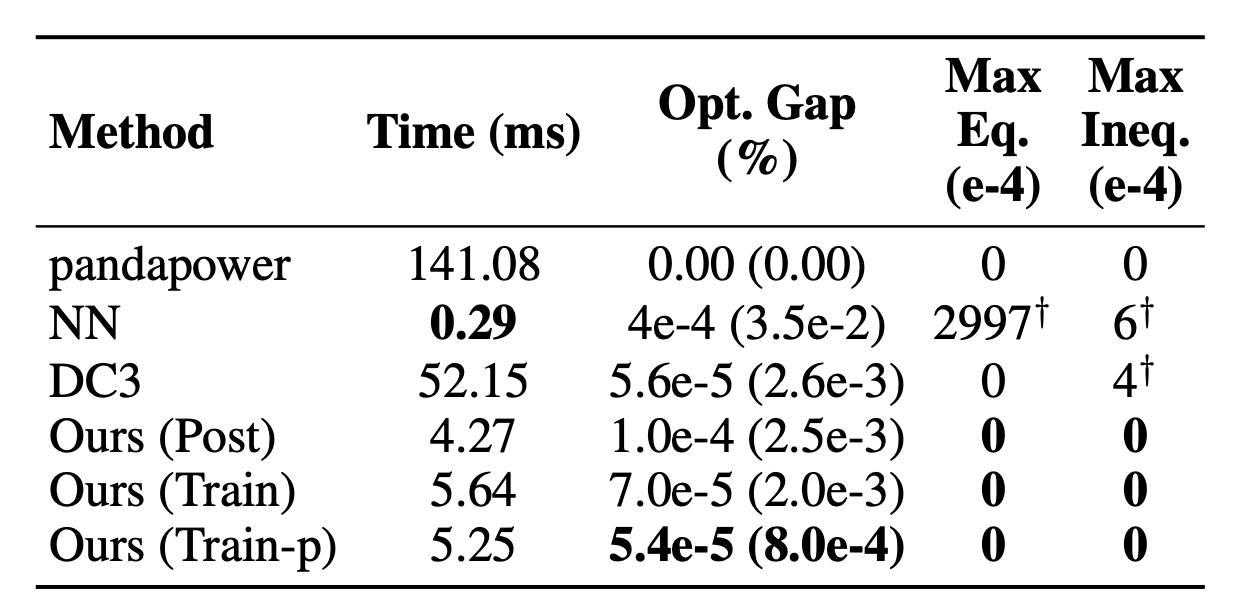
▲DCOPF(IEEE 118-bus)完整指标对比表