Recently, a research team led by ZJUI Assist. Prof. Qian Chao made significant progress in the intelligent design of metasurfaces. By introducing a physics-informed adaptive screening mechanism, the team successfully achieved the robust transfer of design knowledge for complex micro-nano structures across different scenarios. Relevant findings have been published in Laser & Photonics Reviews, a prestigious international journal in optics (CAS Category 1, Impact Factor = 10.0). Huang Can, a 2024 Master student in Electronic Information, is the first author of the paper.
▲
Metasurfaces can precisely manipulate light fields via microstructures, yet practical device design faces challenges of complex spectral dependence. Existing intelligent design methods are mostly confined to a "single-frequency, single-model" paradigm, hindering efficient knowledge transfer across broad frequency ranges. Traditional transfer learning, lacking physical mechanism guidance, often causes "negative transfer" where source domain knowledge interferes with target learning, making it critical to endow algorithms with the ability to distinguish universal physical laws from frequency-specific noise for robust broadband design.
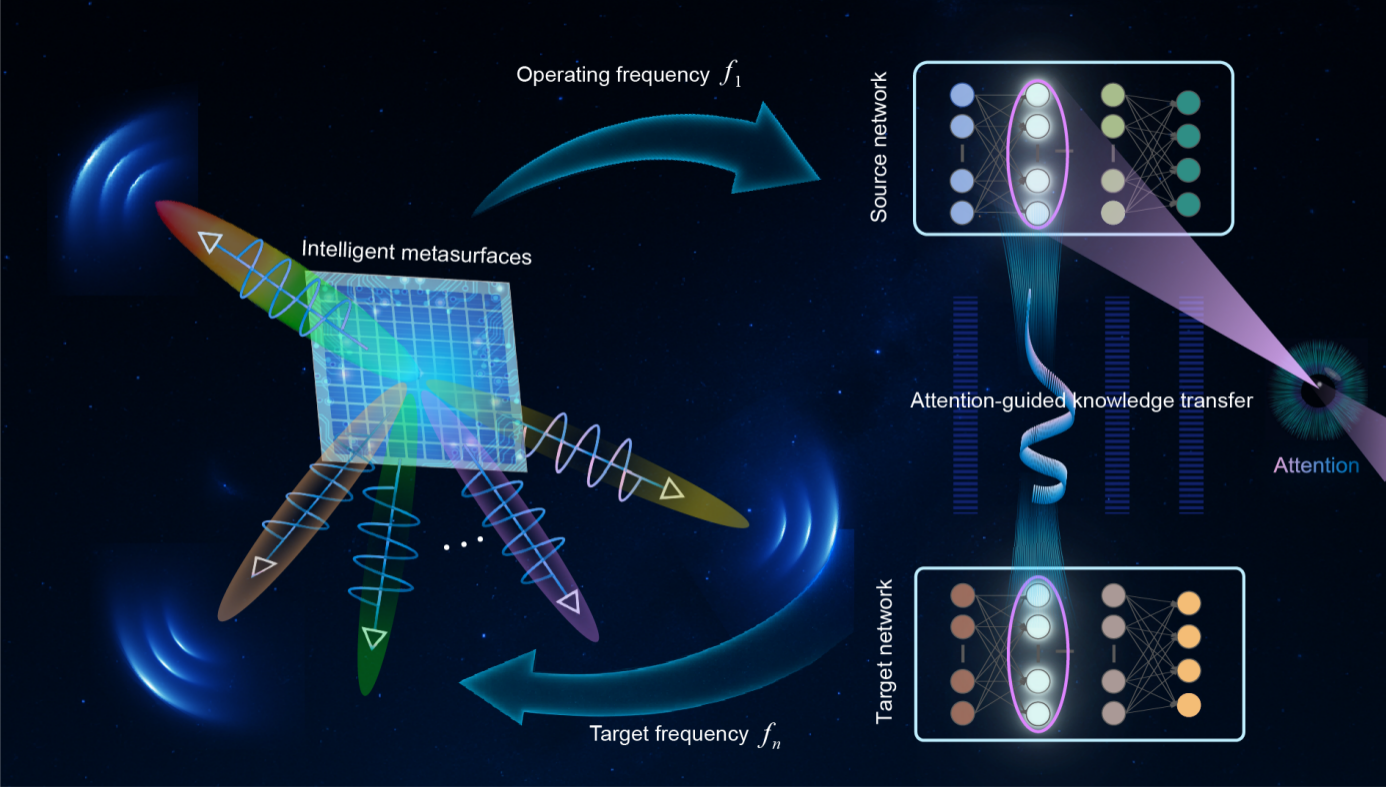
To address these issues, the team proposed an adaptive-guided knowledge transfer framework, centered on a physics-informed adaptive screening module. Mimicking human cognitive filtering, this "intelligent switch" dynamically evaluated the relevance of source domain knowledge based on target field physical properties (e.g., wavelength, wave number), selectively retaining universal cross-domain features while suppressing frequency-specific resonant "noise" instead of blind parameter transfer.
▲
To realize this, a dedicated physical feature analysis architecture was developed. Unlike traditional black-box models that treat frequency as a numerical label, it innovatively integrated a "physics-based frequency encoder" to decouple input frequencies into physically meaningful parameters. These parameters were encoded as high-dimensional contextual signals and injected into an adaptive weighting module to dynamically modulate far-field radiation pattern feature extraction. Additionally, a physics-guided beamforming module at the network output ensured generated metasurface phase distributions adhere to wave optics principles.
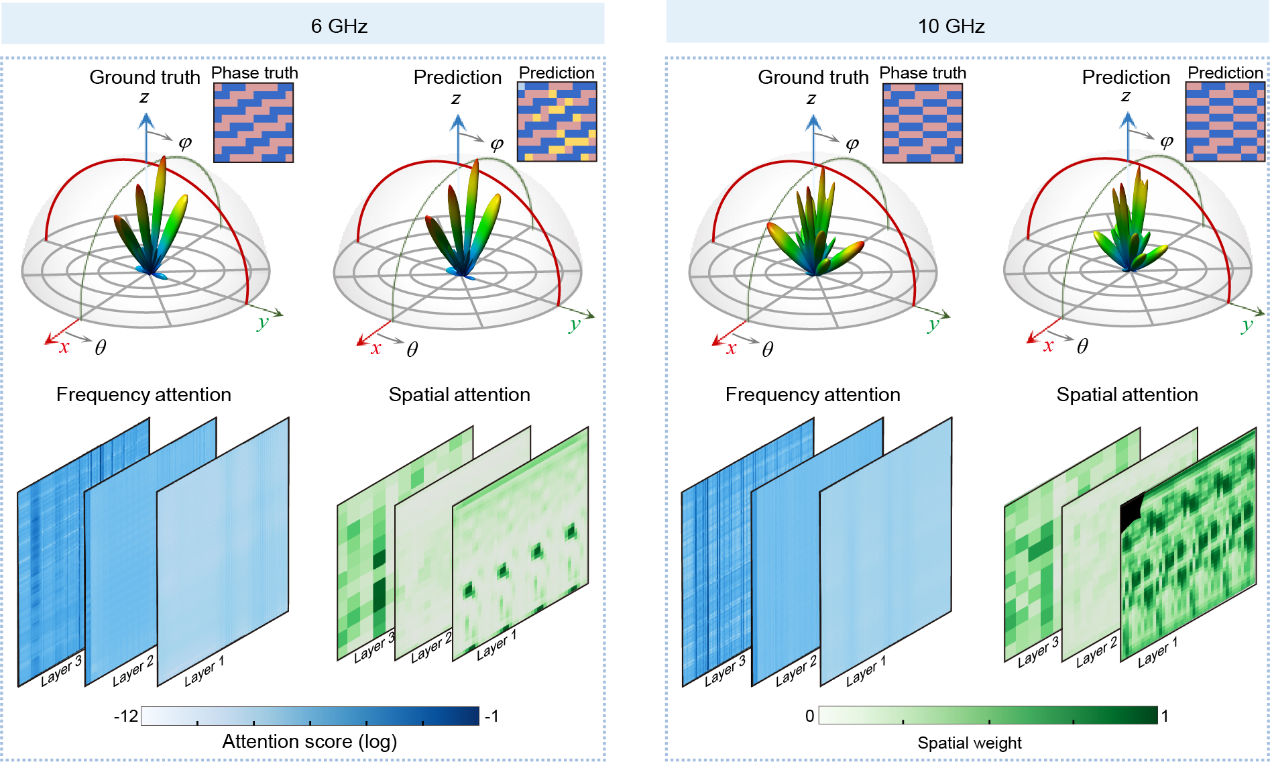
Visualization of network weights revealed the model’s intrinsic physical intuition: a diffuse focus on global phase patterns for low-frequency tasks, and a sharp, localized focus on subwavelength structural details for high-frequency tasks, aligning with the fundamental nature of wave-field interactions.
Broadband validation showed that the frameworks improved prediction accuracy by over 10% compared to traditional full-parameter fine-tuning or direct transfer methods. It also reduced training data requirements by 20% through efficient knowledge reuse, lowering simulation costs for broadband metasurface modeling.
▲
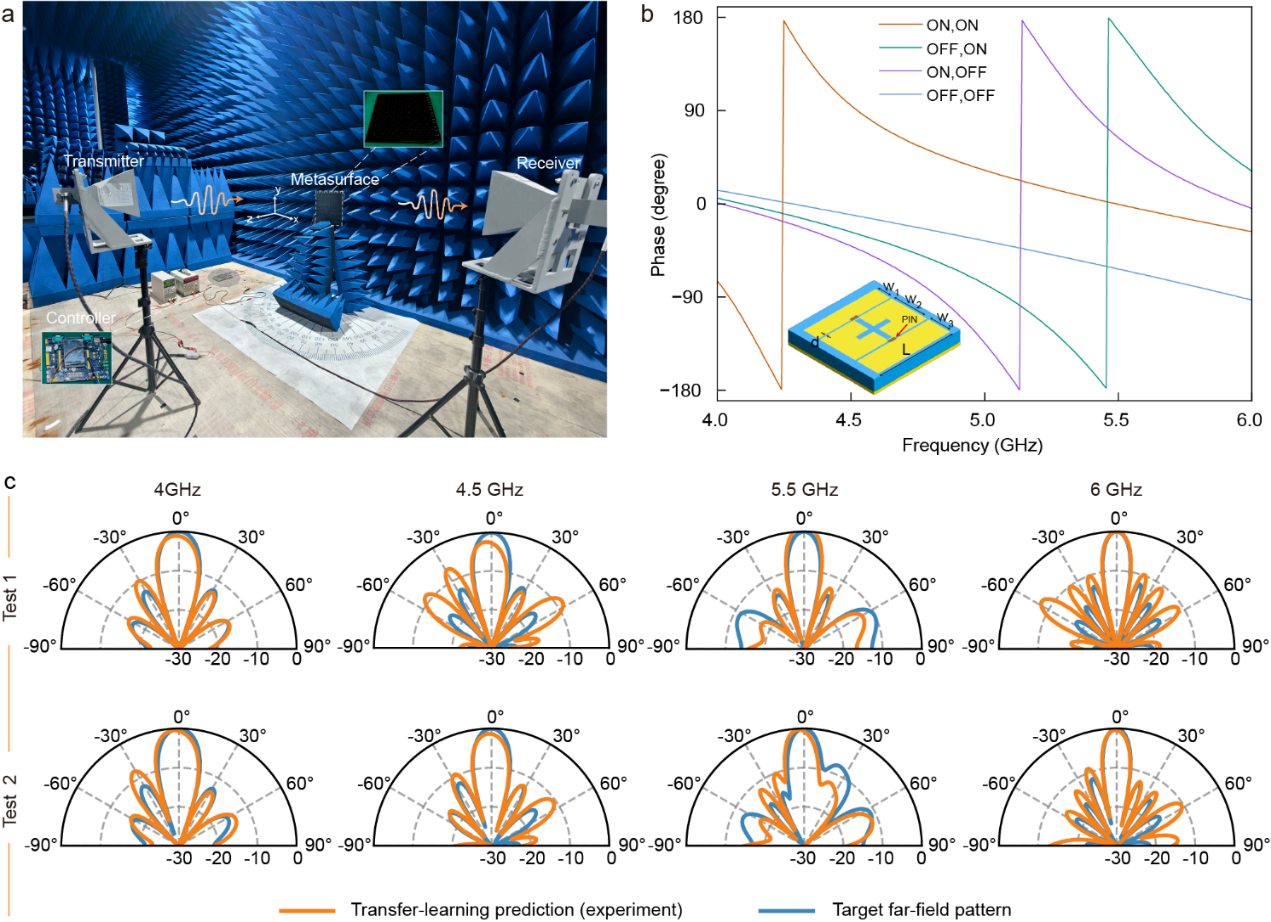
A reconfigurable metasurface prototype was designed and tested in a professional laboratory environment. Experimental results confirmed that the model-generated phase distributions can achieve high alignment with target far-field beams, proving the framework learns intrinsic wave physics rather than merely fitting simulation data.
This work presented an efficient computing paradigm integrating physical priors and adaptive mechanisms, addressing long-standing frequency specificity and negative transfer issues in broadband metasurface inverse design. Its physics-informed design is applicable to terahertz and optical bands, with promising applications in intelligent adaptive metasurfaces, dynamic holography, and wireless communications.