A research team led by Professor Di Dawei at the Zhejiang University-University of Illinois Urbana-Champaign Institute (ZJUI) has made significant progress in improving the operational stability of perovskite light-emitting diodes (PeLEDs). The findings were published in the journal Nature Communications in a paper entitled Addressing the 1000-h/1000-nit stability challenge in perovskite LEDs. Yuan Yucai, a 2026 doctoral graduate in Optical Engineering from Zhejiang University, is the first author, with Professor Di Dawei and Professor Zhao Baodan serving as corresponding authors.
Perovskite LEDs are considered promising candidates for next-generation displays due to their high color purity, excellent luminous efficiency, and flexible device architectures. However, their limited operational stability under high-brightness conditions has remained a major barrier to practical applications.
▲
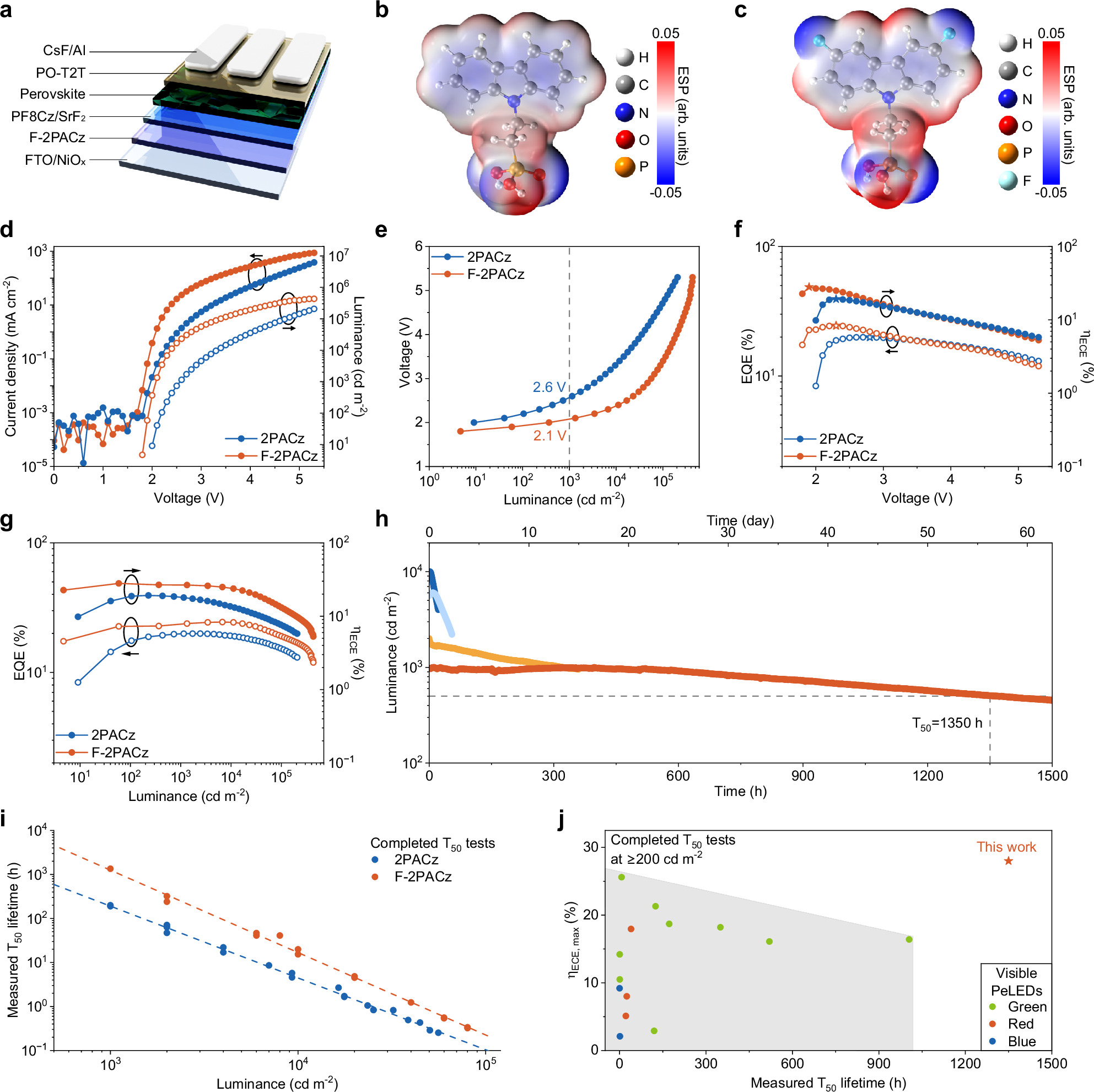
To address this challenge, the research team developed a molecular interface engineering strategy to reduce the operating voltage and enhance device stability. By introducing a fluorinated self-assembled monolayer (F-2PACz) between the nickel oxide (NiOₓ) and polymeric hole-transport layers, the team improved charge injection and reduced the operating voltage from approximately 2.6 V to 2.1 V at a luminance of around 1,000 nits. The optimized green PeLEDs achieved an experimentally measured luminance half-life (T₅₀) of 1,350 hours at an initial luminance of 1,000 nits, together with a maximum electrical-to-optical energy conversion efficiency of 28.0% and a peak external quantum efficiency of 24.5%.

▲
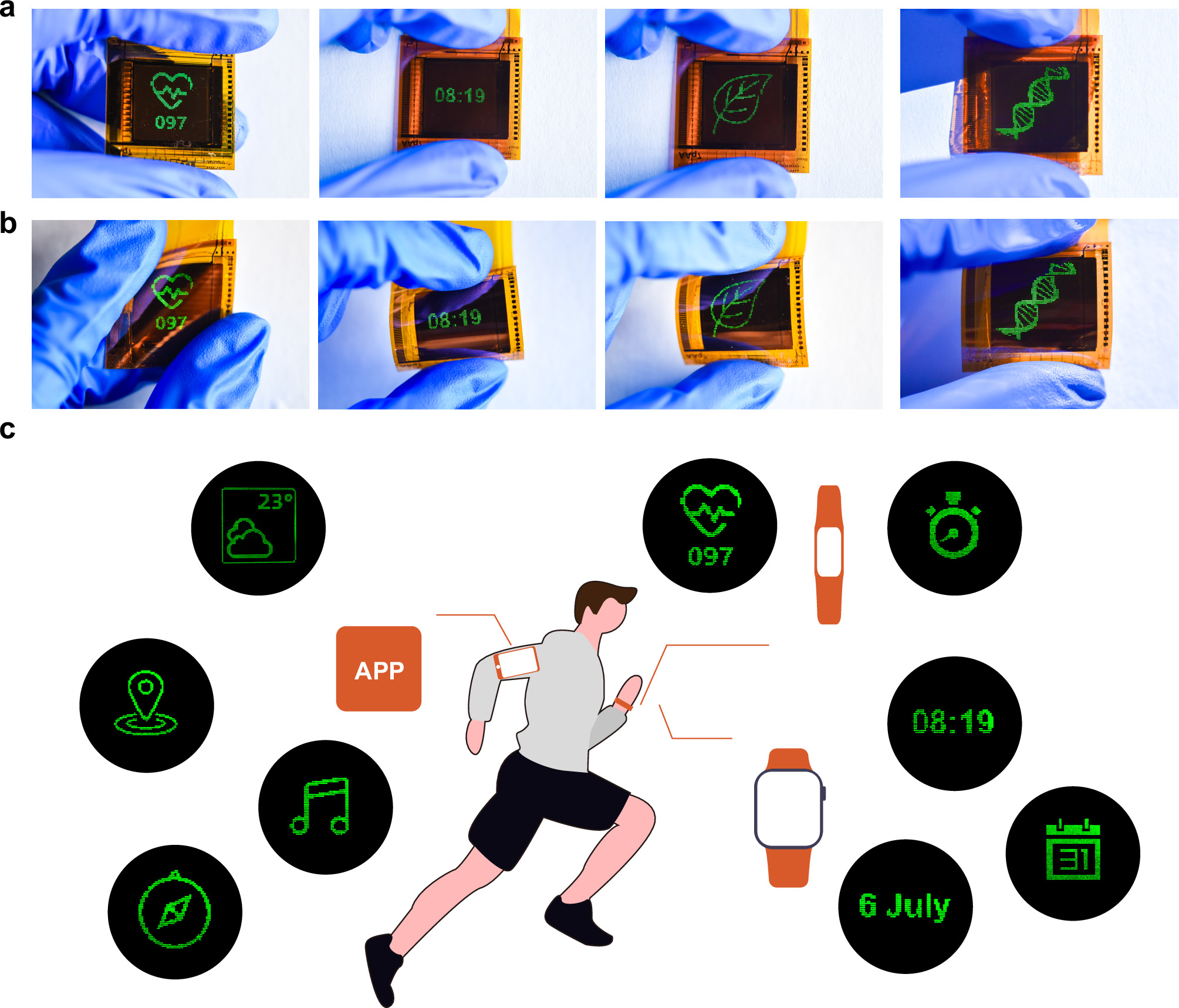
Further investigations revealed that lowering the operating voltage effectively suppresses ion migration, thereby mitigating device degradation and improving long-term stability. The team also successfully integrated PeLEDs with a commercial flexible thin-film transistor (TFT) array to demonstrate a flexible active-matrix PeLED display prototype, capable of displaying patterns under both flat and bent conditions.
▲
These findings demonstrate a promising approach to simultaneously achieving high efficiency and long operational lifetimes in PeLEDs, paving the way for their potential applications in next-generation flexible displays and wearable optoelectronic devices.
The paper was published in Nature Communications, DOI: 10.1038/s41467-026-79298-8.
Paper link: https://www.nature.com/articles/s41467-026-79298-8