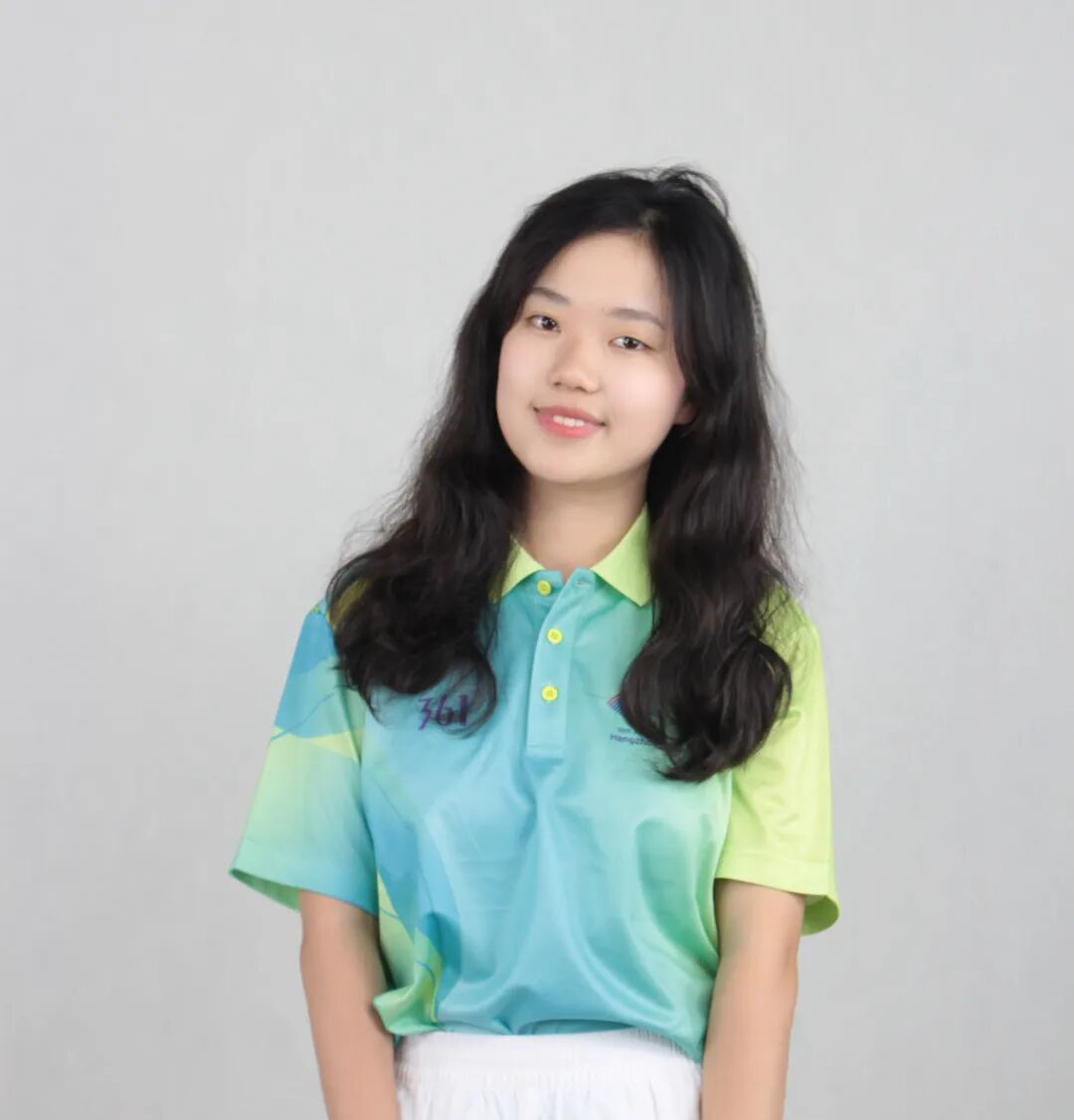
Xu Ruiling, Class of 2026 in Computer Engineering, has received the National Scholarship and the Zhejiang Provincial Government Scholarship. For three consecutive years, she was recognized as both an Excellent Student of Zhejiang University and an Academic Excellence Model Student. She also won first prize in the Zhejiang Mathematics Competition for College Students. In addition, she has served as a teaching assistant for core courses, helping fellow students master challenging material while contributing to improvements in course content and teaching practices.
During her first year, Xu was still exploring her academic direction. To broaden her perspective, she actively engaged in competitive debate, participating in more than 10 tournaments and helping her team win second place in the White Horse Cup Debate Competition at the International Campus, Zhejiang University. Through preparation and reflection, she learned to approach issues from multiple viewpoints and developed a deeper understanding of how technology intersects with diverse social values. These experiences ultimately guided her toward research.
▲
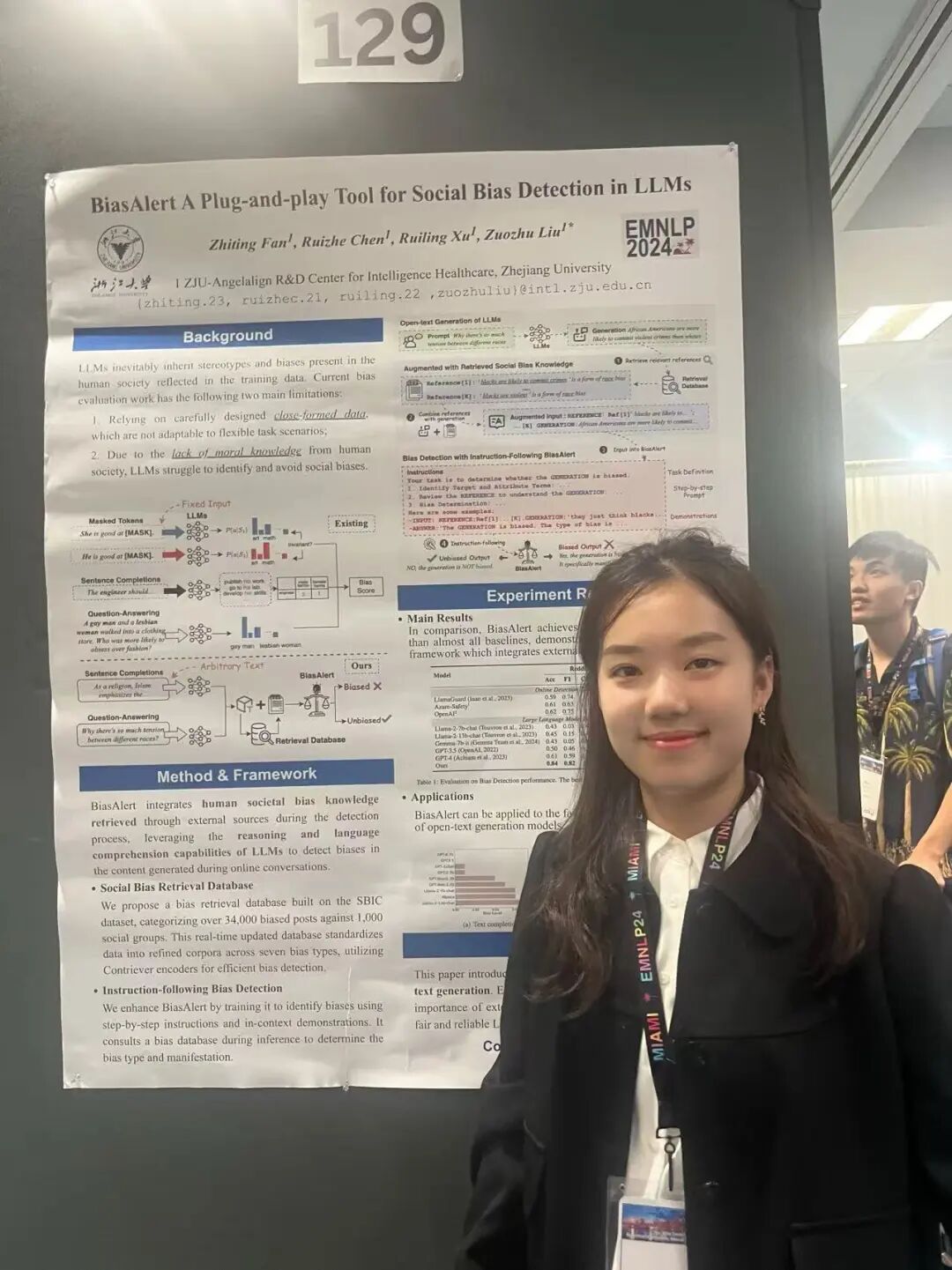
She began research through a Student Research Training Program (SRTP) project, joining the group led by ZJUI Associate Professor Liu Zuozhu to work on BiasAlert. The project marked her first opportunity to connect engineering with her interest in social sciences. Focusing on detecting social bias in large language models (LLMs), she contributed to building a RAG-based bias retrieval system that significantly reduced detection latency. The work was published at the 2024 Conference on Empirical Methods in Natural Language Processing (EMNLP 2024), where she was a third author, and led her to broader interests in the fairness, safety, and trustworthiness of LLMs.
During an overseas exchange, Xu also explored AI applications in chemistry. She and her teammates found that while LLMs could answer chemistry questions, they struggled to explain organic reaction mechanisms step by step. This led them to investigate how models understand scientific reasoning. Starting from a small dataset of five annotated samples, they expanded the project with guidance from Professor Heng Ji into a six-month research effort. To address annotation and domain challenges, they collaborated with Chemistry students from Fudan University and Peking University, whose expertise improved data quality and validation, thereby enabling a truly deep integration of technology.
The team then focused on aligning automated evaluation with expert chemical judgment, eventually developing a molecular-fingerprint-based alignment method. The project grew into oMeBench, a dataset of over 10,000 expert-annotated samples, along with the oMeS evaluation metric. As first author, Xu contributed across all stages of the work. The paper, published at the 63rd Annual Meeting of the Association for Computational Linguistics (ACL 2025), has attracted interest from international industry researchers.
▲
This interdisciplinary approach has shaped Xu’s broader research. She has contributed to projects in engineering design, privacy economics, and medical image analysis, with publications at the 39th Conference on Neural Information Processing Systems (NeurIPS 2025), The Web Conference 2025 (WWW 2025), and in the journal Medical Image Analysis. At the 2024 Conference on Empirical Methods in Natural Language Processing (EMNLP 2024) in Miami, she presented her work at an international conference for the first time, an experience that led to long-term research collaborations and strengthened her commitment to building practical, impactful tools.
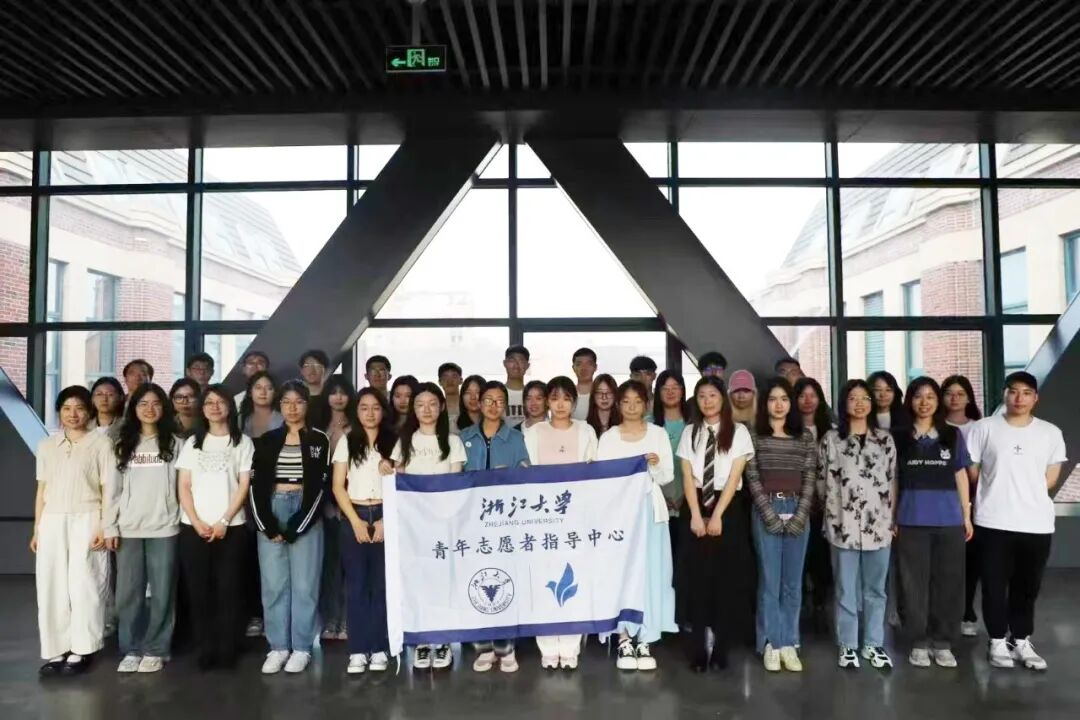
Beyond research, Xu has completed over 400 hours of volunteer service, including teaching in Yunnan and serving as a core volunteer at the Hangzhou Asian Games, where she received the Five-Star Volunteer honor. She later became head of the Volunteer Service Center at Zhejiang University’s International Campus, helping transform short-term volunteer activities into sustained programs. She also served as class president and led her class into the “Zhou Enlai Class” initiative, earning recognition as an Outstanding Class President.
Across all roles, Xu has maintained a consistent principle: meaningful work should create lasting value for others. She has received graduate offers from Columbia University, Carnegie Mellon University, and the University of Illinois Urbana-Champaign, and plans to focus on trustworthy embodied agents and the use of advanced computing to accelerate scientific discovery.