A research team led by Assistant Professor Qian Chao at the Zhejiang University–University of Illinois Urbana-Champaign Institute (ZJUI) proposed and experimentally demonstrated a temporally encoded parallel nonlinear metasurface processor for photonic neuromorphic computing and intelligent optical computing. The paper titled Parallel Nonlinear Neuromorphic Computing with Temporal Encoding, was published in Science Advances.
You Guangfeng, a doctoral student in Electronic Science and Technology at Zhejiang University, is the first author. Assistant Professor Qian Chao and Professor Chen Hongsheng of the College of Information Science and Electronic Engineering, Zhejiang University are the co-corresponding authors. Zhejiang University is the sole corresponding institution.
▲
As advanced computing technologies continue to evolve, there is increasing demand for low-power and high-performance hardware. Neuromorphic photonic computing leverages the speed and parallelism of light for high-throughput information processing, but its development is still limited by the efficiency and flexibility of conventional nonlinear materials and optoelectronic approaches.
▲
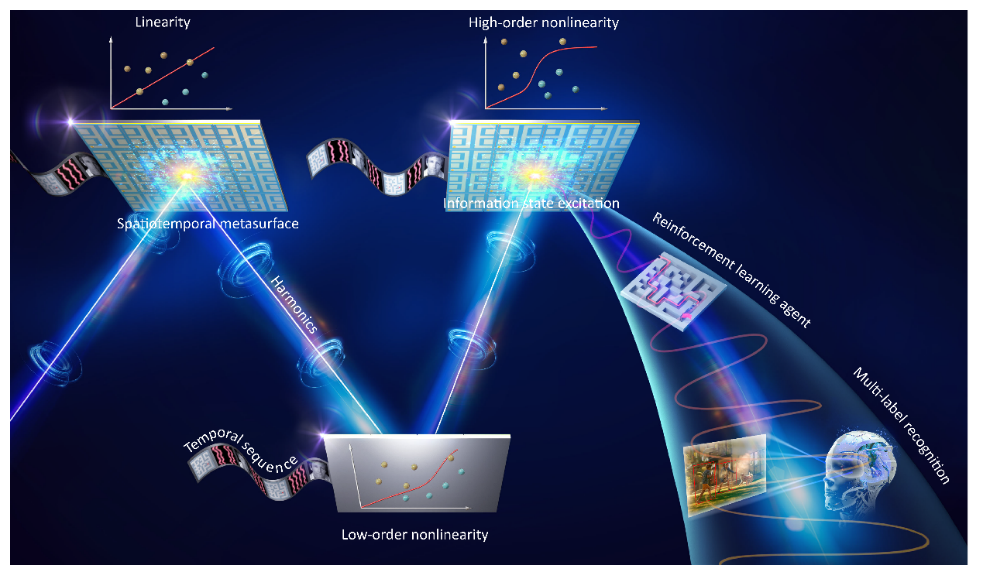
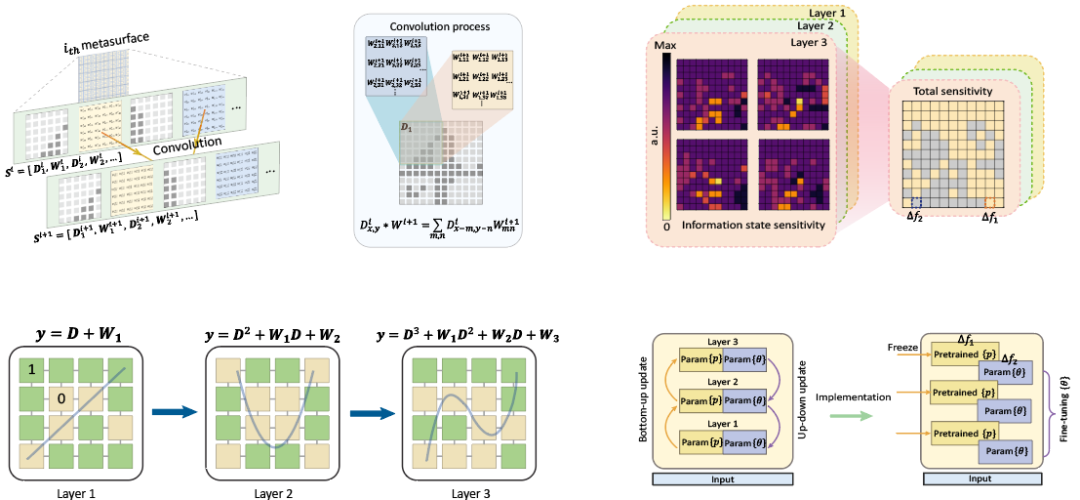
To overcome this limitation, the team developed a parallel nonlinear neuromorphic metasurface processor. It generates an effective nonlinear response through multiple scattering without relying on intrinsic nonlinear materials or high-power excitation. The system output is formed by cascading linear responses of multiple layers, enabling both linear transformations and nonlinear function approximation.
▲
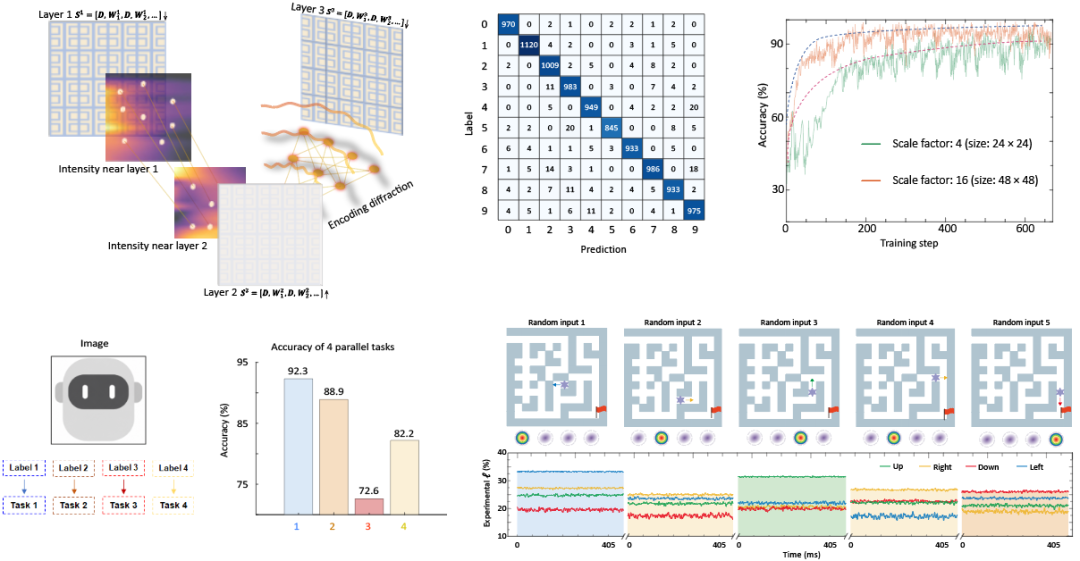
The team introduced a temporal encoding strategy that maps inputs and weights into time-sequenced signals processed by cascaded metasurfaces. Each layer performs linear scattering, and their combined response produces effective nonlinear computation. The nonlinear order can be increased by adding more layers, while the same platform supports parallel processing of multiple tasks.
The system was demonstrated in image recognition and maze-solving tasks, showing flexibility in handling different input sizes and strong multitask capability, including simultaneous facial expression and gender classification. It also exhibited neural network emulation and path-planning ability based on historical information.
Overall, the work provides a scalable route to effective nonlinearity through multilayer linear scattering, offering a new framework for physical neural networks and potential applications in intelligent metasurfaces and low-power edge computing.
Paper Link: https://www.science.org/doi/10.1126/sciadv.aea1114