A research team led by Associate Professor Hu Huan at the Zhejiang University–University of Illinois Urbana-Champaign Institute (ZJUI) has made advances in the interface engineering of two-dimensional materials. The study, titled Threshold Force Study for the Scanning Probe-Based 2D Material Bubble Removal Method, was presented at the 2026 IEEE International Conference on Manipulation, Manufacturing and Measurement on the Nanoscale (3M-NANO 2026), where it received the Best Student Paper Award.
Du Kaitai, a 2025 master's student in Mechanical Engineering at Zhejiang University, is the first author. Associate Professor Hu Huan is the sole corresponding author. The co-authors include Associate Professor Huang Changjin and Lei Ziyang, a 2025 master's student in Mechanical Engineering, both from Singapore Nanyang Technological University.
▲
Two-dimensional material heterostructures hold great promise for applications in electronic, optoelectronic, and quantum information devices. However, interfacial bubbles that form during transfer and assembly processes can degrade layer–layer contact quality and compromise device performance. While scanning probes offer a feasible means of bubble removal, the underlying mechanism and its dependence on applied load remain poorly understood. Current approaches largely rely on empirical parameter tuning, which limits their applicability to precision manufacturing.
▲
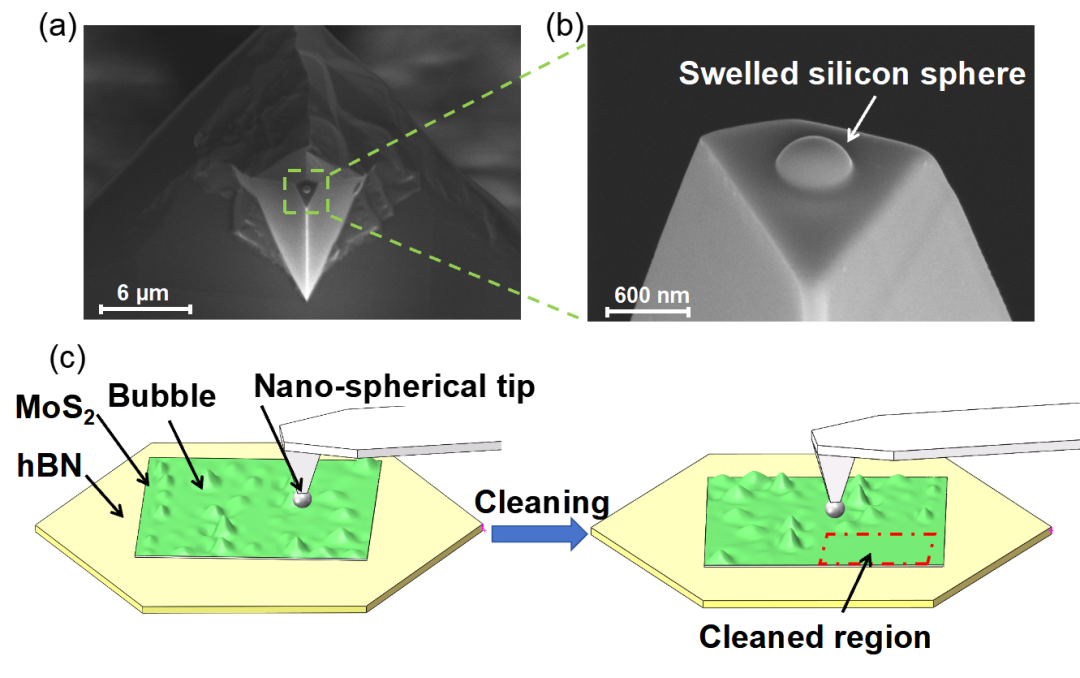
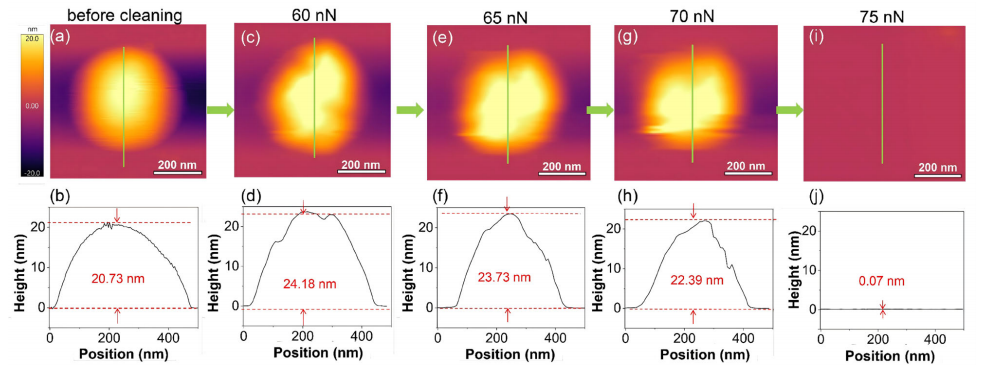
To address this challenge, the research team developed a scanning-probe-based method to investigate the threshold force required for bubble removal. A nanosphere probe was employed to apply controlled normal loads, while high-resolution topographic imaging was used to monitor bubble migration and disappearance under varying load conditions.
The results revealed a distinct threshold behavior: below a critical load, bubbles persist even after repeated scanning, whereas above the threshold, they rapidly migrate and vanish. This indicated that bubble removal is governed by the magnitude of the applied force rather than the number of scanning cycles. Further quantitative analysis established a correlation between bubble geometry and the removal threshold, with bubble height identified as the dominant parameter for predicting the required loading conditions.
Collectively, this work provides a mechanics-based framework for understanding and predicting interfacial bubble removal, paving the way toward more reliable defect control and precision fabrication of van der Waals heterostructures at the nanoscale.
▲