The IEEE Computer Society recently announced the recipients of its 2025 Best Paper Awards. A total of 22 papers were selected this year from 20 of the Society’s flagship publications in recognition of their outstanding research contributions.
A research team led by Professor Wu Yingcai at the Zhejiang University–University of Illinois Urbana-Champaign Institute (ZJUI) has received international recognition for its contributions to visualization and visual analytics. The team’s paper, ChartGPT: Leveraging LLMs to Generate Charts From Abstract Natural Language, was published in IEEE Transactions on Visualization and Computer Graphics (TVCG), a leading international journal ranked as a CCF A journal, and received the journal’s 2025 Best Paper Award in Visualization and Visual Analytics. Tian Yuan, a 2022 doctoral student in Computer Science and Technology of Zhejiang University, is the first author. Professor Wu Yingcai of ZJUI and Researcher Deng Dazhen at the School of Software Technology of Zhejiang University are the corresponding authors.
In 2025, TVCG participated in the IEEE Computer Society’s Best Paper Awards program for the first time, with awards presented in three categories: Computer Graphics, Visualization and Visual Analytics, and Virtual and Augmented Reality. Among more than 800 papers published in TVCG in 2025, only three papers—one in each category—were selected for this honor.
▲
The paper observes that natural language interfaces (NLIs) for chart creation have gained growing traction, owing to the intuitive nature of natural language-based human-computer interaction. A critical bottleneck hindering the broad adoption of such NLIs lies in accurately distilling user intent and translating it into valid chart specifications. In practice, users tend to submit vague, underspecified natural language queries that lack explicit descriptions of visual encodings, an issue that severely limits the real-world applicability of natural language-driven chart generation systems.
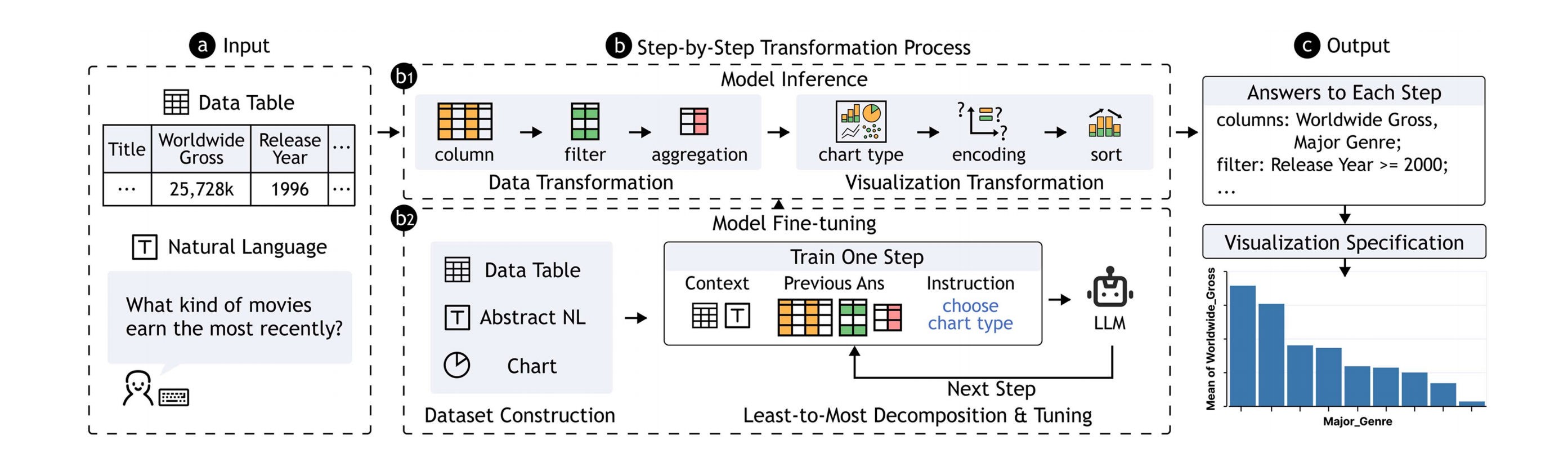
Pretrained large language models (LLMs) have recently achieved remarkable proficiency in natural language comprehension and generation, unlocking substantial promise for downstream visual analytics tasks. Motivated by this progress, the team present ChartGPT, a framework tailored to synthesize charts from ambiguous natural language prompts. Nevertheless, vanilla LLMs inherently struggle with multi-step logical reasoning. To equip the model to formulate intricate chart parameters and execute structured visualization workflows precisely, the team break down the end-to-end chart generation pipeline into sequential, interpretable reasoning subtasks. This design confines the model’s focus to one distinct, well-defined subproblem at each inference stage.
Additionally, LLMs are pre-trained on broad, general corpora, leaving them ill-equipped to handle domain-specific chart generation workflows. To inject specialized visualization knowledge into the model, the team construct a paired dataset of ambiguous user utterances and their corresponding target charts, then boost the model’s domain performance via targeted fine-tuning. The team further integrate a human-in-the-loop interactive interface into ChartGPT, enabling users to inspect, adjust, and iterate on intermediate reasoning outputs at every pipeline stage.
Paper Link:https://ieeexplore.ieee.org/document/10443572