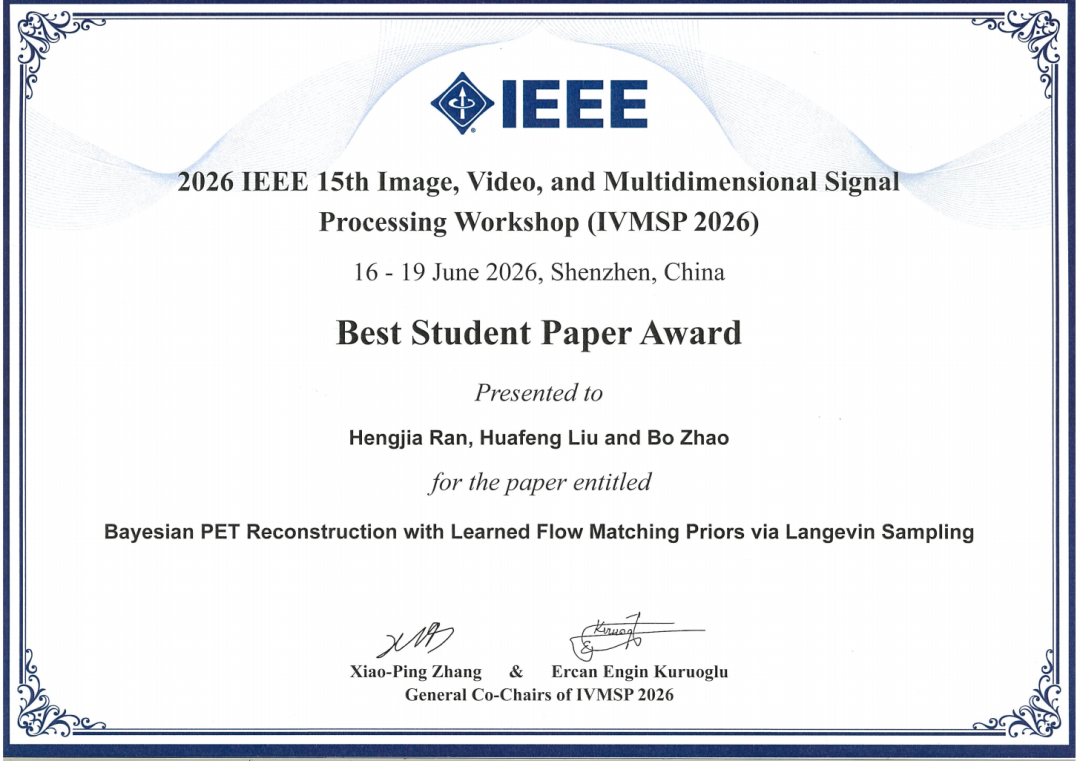
A research team led by Associate Professor Zhao Bo at the Zhejiang University–University of Illinois Urbana-Champaign Institute (ZJUI) has recently made significant progress at the intersection of medical image reconstruction and advanced computational technologies. The paper Bayesian PET Reconstruction with Learned Flow Matching Priors via Langevin Sampling was presented at the IEEE 15th Image, Video, and Multidimensional Signal Processing Workshop (IVMSP 2026), where it received the Best Student Paper Award. Ran Hengjia, a 2025 doctoral student in Information and Communication Engineering, is the first author, and Associate Professor Zhao Bo is the sole corresponding author. The second author is Professor Liu Huafeng from the College of Biomedical Engineering and Instrument Science, Zhejiang University.
Positron emission tomography (PET) is an important medical tomographic imaging technique. By detecting pairs of annihilation photons generated by radiotracers inside the human body, PET reconstructs the distribution of metabolic activity across tissues and organs. It is widely used in cancer diagnosis, neurological disease assessment, and cardiovascular disease research. From the perspective of signal processing and inverse problems, PET reconstruction aims to recover high-dimensional images from low-count measurements dominated by Poisson noise, making it a low signal-to-noise and highly ill-posed statistical estimation problem. Clinically, reducing radiotracer injection doses or shortening scan duration can help decrease patients’ radiation exposure and improve examination efficiency. However, these measures also significantly reduce photon counts, leading to increased noise, more severe artifacts, and loss of fine image details. Therefore, achieving high-quality PET image reconstruction under low-dose conditions remains an important challenge at the intersection of medical imaging, signal processing, and computer technologies.
▲
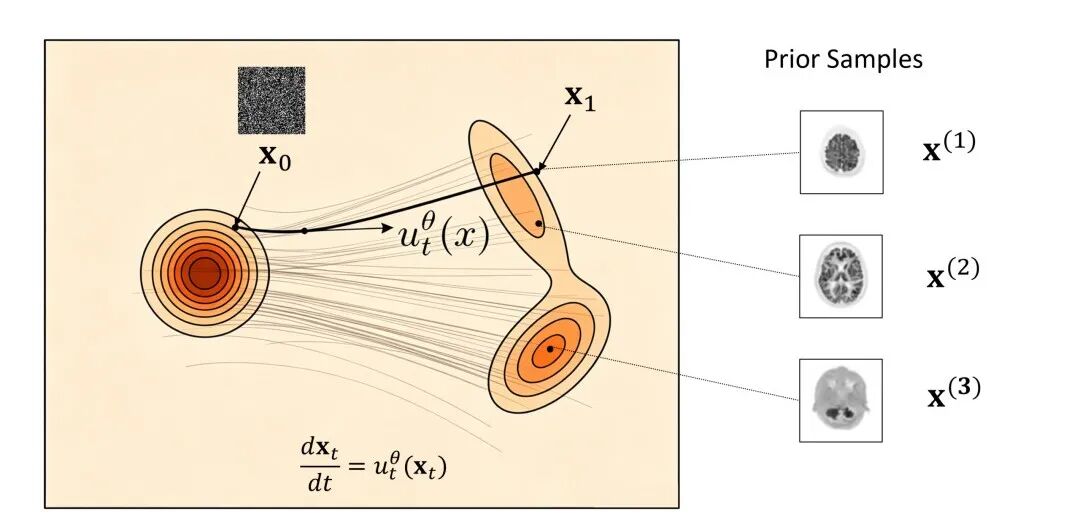
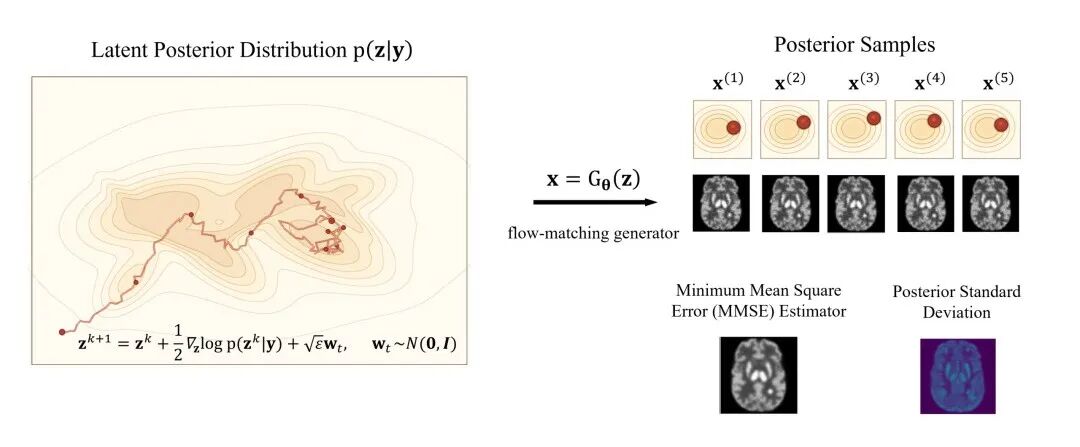
To address these challenges, the research team proposed a Bayesian PET reconstruction method based on a Flow Matching generative prior. The method trains a generative model using existing PET imaging datasets to learn the prior distribution of real medical images. This learned prior is then integrated with the PET imaging physics model and Poisson noise statistics to construct a Bayesian posterior model for low-dose PET reconstruction. At the algorithmic level, the team designed a latent-space Langevin posterior sampling method, transforming the high-dimensional PET image reconstruction problem into a Bayesian inference problem in the latent space of the generative model. This enables the reconstruction results to remain physically consistent with PET projection measurements while effectively suppressing noise and artifacts caused by low-count observations.
Compared with traditional reconstruction methods, the proposed approach not only better preserves tissue structures, edges, and fine details, but also provides voxel-level uncertainty estimation through multiple posterior samples. This allows the reliability of reconstruction results in different tissue regions and potential lesion areas to be intuitively reflected. Such capability extends PET reconstruction beyond conventional single-image estimation toward posterior distribution characterization, helping evaluate the reliability of image details and providing useful reference for subsequent lesion analysis, quantitative measurement, and clinical decision support.
▲
By combining a Flow Matching-based generative model, PET imaging physics, and Bayesian posterior inference, this study presents a new framework for high-quality and trustworthy low-dose PET imaging. It offers a novel technical pathway toward low-dose PET image reconstruction with improved precision and quantifiable reliability. The work received the Best Student Paper Award at IVMSP 2026, demonstrating the international research community's recognition of its innovative approach and scientific contributions. Moving forward, the research team will continue to advance this work by addressing clinical needs, improving algorithmic efficiency and system robustness, and accelerating the transition of the technology from proof-of-concept validation toward real-world clinical applications.