Recently, a team led by Assistant Professor Qian Chao of the Zhejiang University–University of Illinois Urbana-Champaign Institute (ZJUI), together with Professor Chen Hongsheng of the College of Information Science and Electronic Engineering, Zhejiang University, Assistant Research Fellow Yuan Fang of the National University of Defense Technology, and Professor Romain Fleury of École Polytechnique Fédérale de Lausanne (EPFL), developed a model-free approach to creating computational spaces for physical neural networks. The study, which advances research in physical neural networks and matter intelligence, was published in Nature Communications.
Song Mingfei, a 2024 master’s student in Electronic Information at Zhejiang University, is the first author of the paper. Assistant Professor Qian Chao of ZJUI, Assistant Research Fellow Yuan Fang of the National University of Defense Technology, Professor Romain Fleury of EPFL, and Professor Chen Hongsheng of the College of Information Science and Electronic Engineering, Zhejiang University are the corresponding authors. The co-authors also include Assistant Professor Wang Gao'ang of ZJUI, Postdoctoral Researcher Ali Momeni of EPFL, and Senior Engineer Li Cheng of the National University of Defense Technology.
Physical neural networks (PNNs) process information directly via wave fields, boasting inherent advantages in speed and energy efficiency over conventional digital computing architectures. However, their real-world deployment has long been constrained by their reliance on precise mathematical models and backpropagation, both of which are difficult to implement in complex environments marked by multipath scattering, environmental perturbations, and intricate coupling effects.
▲
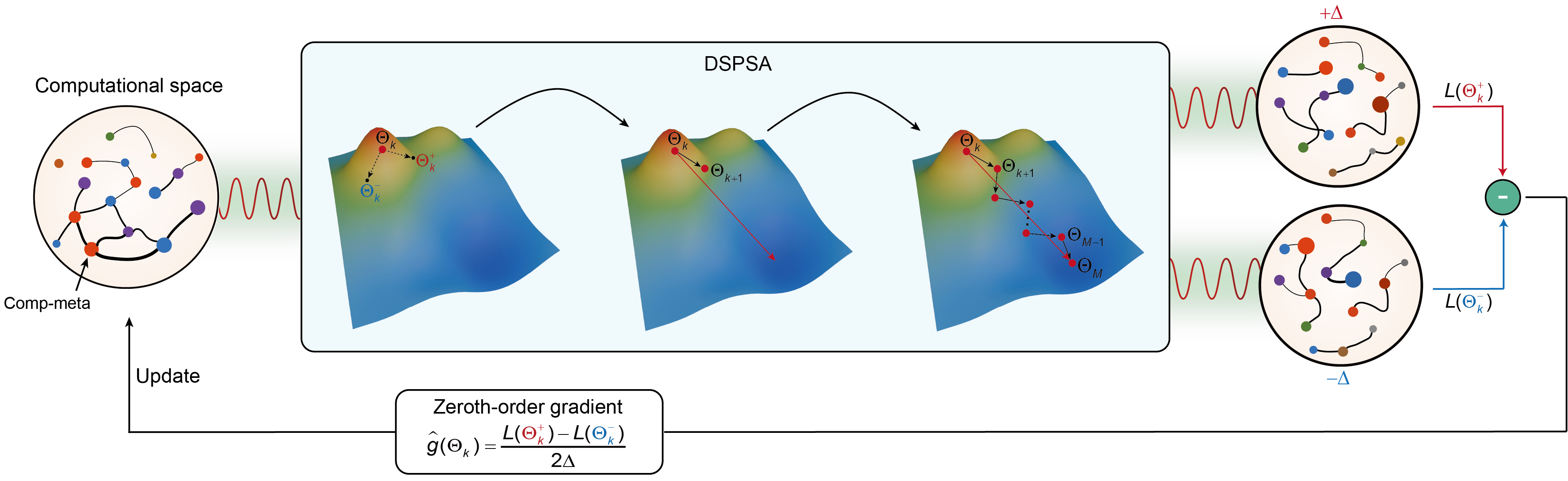
To overcome this bottleneck, the research team proposed a computational space framework that treats the entire physical environment as a trainable neural network. Distributed metasurfaces shaped electromagnetic waves throughout their propagation, scattering, interference and coupling, enabling the surrounding space to function as both an information transmission channel and an active computational substrate.
▲
To endow this computational space with autonomous learning capabilities, the team further developed a model-free, fully forward training paradigm. Drawing directly on experimentally measured physical feedback signals, the system optimized metasurface configurations without the need for digital twin models or backpropagated gradients, enabling true in-situ learning within the physical environment itself.
Experimental validation yielded strong results across multiple tasks. The system achieved wave energy focusing in complex scattering environments, boosting signal intensity at target locations by over 14 dB. For object recognition, it reached above 95% accuracy in identifying letters and digits. In human localization tasks, it accurately distinguished human positions across distinct spatial zones, with robust performance even against posture changes and position offsets.
▲
By eliminating the dependency on precise physical models, this study unlocked the possibility of transforming everyday surfaces, walls, ceilings, furniture and even entire rooms, into intelligent computational systems, giving rise to a novel form of matter intelligence. Going forward, the team will integrate nonlinear physical devices and adaptive online learning mechanisms to further enhance learning capacity and generalization, advancing real-world applications in smart homes, human-computer interaction, autonomous driving and related fields.