A research team led by Associate Professor Oleksiy Penkov at the Zhejiang University-University of Illinois Urbana-Champaign Institute (ZJUI) has spent the past six years tackling common but often overlooked challenges in advanced materials laboratories, which are fragmented data, poorly traceable processes, and experimental results that are difficult to revisit or reproduce.
Rather than relying on a single off-the-shelf platform, the team built an integrated digital infrastructure that connects the full lifecycle of laboratory data, from automatic data capture at the equipment level to structured experiment management and intelligent data retrieval and analysis. The goal was not simply to introduce new digital tools, but to create a reliable, traceable foundation for data-driven research.
In advanced materials research, data such as diffraction patterns, microscopy images, processing parameters, and mechanical testing results are generated continuously. Yet in many laboratories, these records remain scattered across paper notebooks, personal computers, and spreadsheets. When researchers need to compare samples, trace batch histories, or identify the source of an anomaly, they often have to search through logs, match files manually, and reconstruct experimental contexts, a process that can feel more like “data archaeology” than scientific analysis.
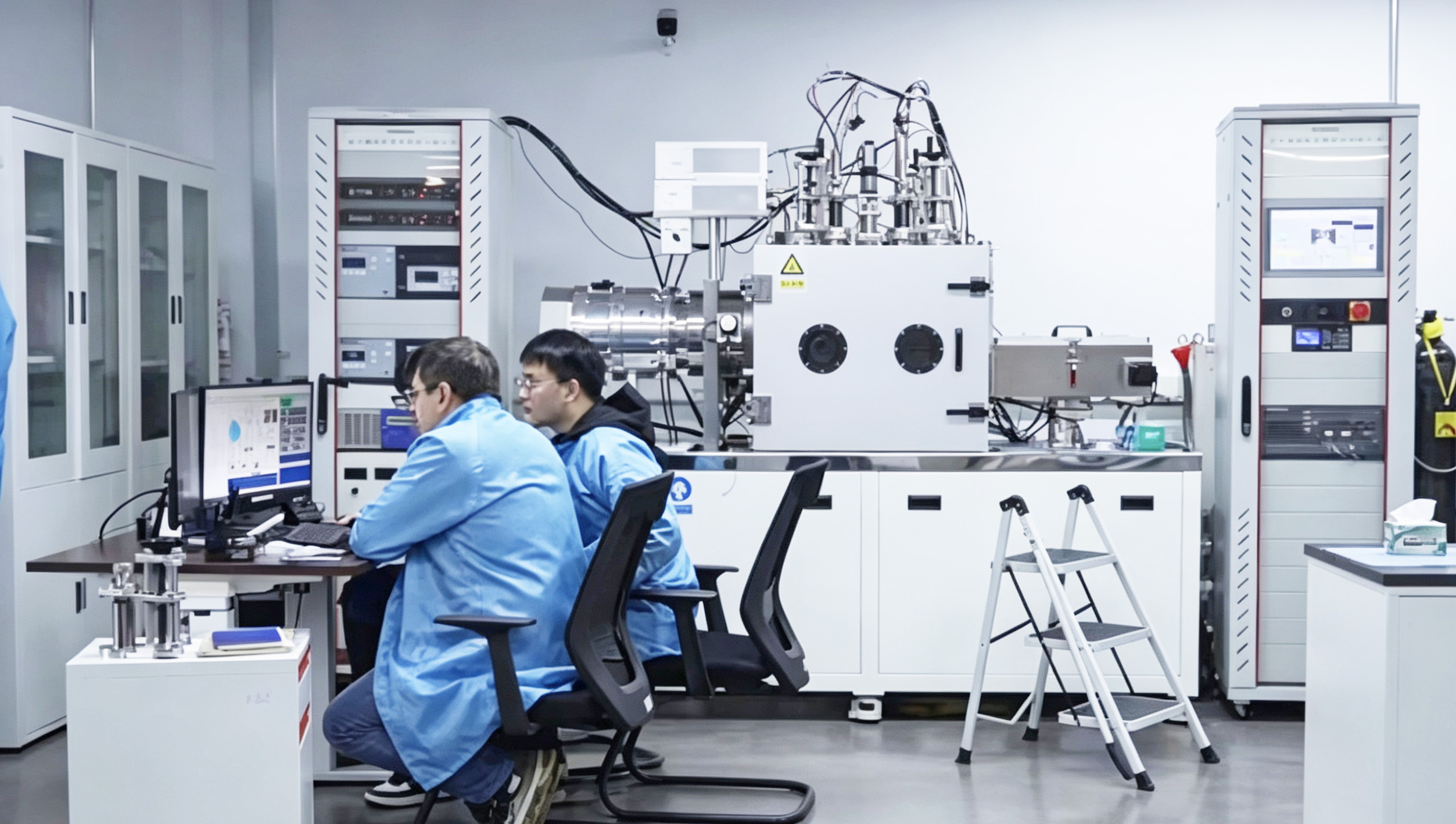
To address this bottleneck, ZJUI Associate Professor Oleksiy Penkov’s team developed their own control and logging software for existing magnetron sputtering equipment. The system automatically records 32 channels of experimental parameters at second-level intervals during deposition, saving the process history as readable and traceable plain-text logs.
Building on this foundation, the team introduced E-LabNotebook in 2021 and established a hierarchical system linking projects, folders, samples, operations, and files. Test results from XRD, SEM, nanoindentation, and other techniques can now be connected directly to the corresponding samples, instruments, procedures, and raw data. To date, the system has recorded 19 research projects, hundreds of samples, and thousands of data files, preserving five consecutive years of research activity in a structured format.
As the data infrastructure matured, the team further developed an MCP (Model Context Protocol) server to connect large language models with the electronic lab notebook, equipment logs, and analysis results. This enables researchers to retrieve recipes, parse logs, compare datasets, and identify potential sources of experimental issues through natural language instructions. In one comparative experiment involving W/B4C multilayer mirrors, the system quickly traced an abnormal interface-layer thickness to differences in power-supply output, reducing a manual troubleshooting process that typically takes one to two days to just a few minutes.
The work highlights a key lesson for digital research. Intelligent tools are only as effective as the data infrastructure behind them. Through six years of sustained effort, their experience not only greatly improves research efficiency, but also offers a practical reference for other laboratories pursuing digital transformation.