Recently, a research team led by Assistant Professor Lin Fanfan of the Zhejiang University–University of Illinois Urbana-Champaign Institute (ZJUI), in collaboration with scholars from China, Australia, the United States, Spain and Sweden, published a review article on smart grids and frontier computing technologies in Nature Reviews Electrical Engineering. Assistant Professor Lin Fanfan serves as a co-first author and corresponding author, with ZJUI as the sole corresponding institution.
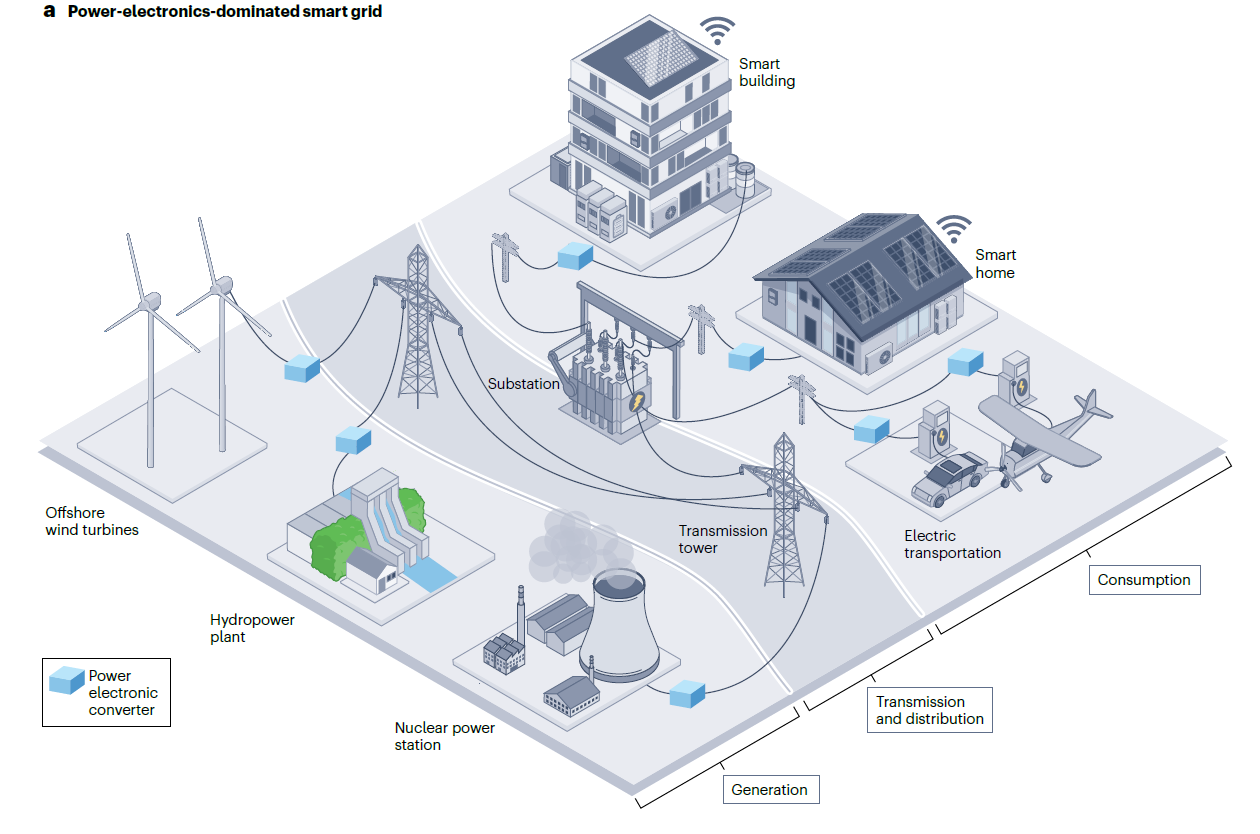
Against the backdrop of accelerating global energy transition and the deepening implementation of China’s “dual carbon” goals, power systems are undergoing a profound transformation from traditional centralized grids into complex energy systems that deeply integrate renewable energy sources, energy storage, electric vehicles, distributed resources and intelligent terminals. The large-scale integration of high-proportion wind and solar generation has significantly increased the uncertainty of grid operation, placing unprecedented demands on real-time situational awareness, dynamic dispatch and fine-grained control. Meanwhile, power electronic converters have emerged as the core interfaces connecting renewable energy sources, energy storage systems and end-use loads, forming the fundamental building blocks of future power grids. The widespread adoption of wide-bandgap (WBG) semiconductors, particularly silicon carbide (SiC) and gallium nitride (GaN), in high-voltage, high-frequency and high-power-density applications has dramatically improved the performance of power electronic systems, but at the same time introduced substantially higher computational complexity to their design, simulation, control and reliability assessment.
▲
The article demonstrates that the inherent variability of renewable generation, the proliferation of distributed energy resources, and the stochastic nature of load behavior have significantly increased the complexity of grid operation and optimization, requiring decision-making to be performed at larger scales, higher dimensions, and under more stringent constraints. The dramatic increase in power device switching speeds and the growing integration of power electronic systems further necessitate converter analysis that simultaneously accounts for coupled electromagnetic, thermal, and mechanical multiphysics effects across an extremely wide range of timescales, from nanosecond-scale switching transients to multi-year device degradation and lifetime assessment. These paradigm shifts have elevated advanced computational methods to a critical enabling technology for smart grid modeling, real-time operation, fault diagnosis, and cybersecurity.
Departing from conventional research paradigms that treat power electronic systems and grid operation as separate domains, the article conceptualizes smart grids as a tightly coupled two-layer system, composed of a converter layer centered on power electronic converters, and a grid layer comprising distributed resources, loads, energy storage, and network nodes. This layered perspective unifies device-level, equipment-level, and system-level challenges within a single analytical framework, revealing the common scientific and engineering requirements across modeling, control, optimization, and security domains.
The review particularly emphasizes that advanced computational methods are not intended to replace well-established, field-proven power system analysis tools, but rather to complement traditional engineering approaches. Hybrid computing frameworks that integrate classical engineering methodologies with state-of-the-art algorithms and high-performance computing platforms represent the most practical path forward, enabling enhanced design efficiency, operational performance, and maintenance capabilities for power-electronics-dominated smart grids while upholding the highest standards of system safety and reliability. The review also showcases ZJUI's sustained research endeavors and significant contributions in the interdisciplinary fields of future energy systems, advanced computational methods, and international collaborative research.