Recently, a research team led by Associate Professor Said Mikki at the Zhejiang University–University of Illinois Urbana-Champaign Institute (ZJUI) reported advances in physical information theory and stochastic field-based computing. The findings were presented in two papers published in the international journals Entropy and IEEE Transactions on Antennas and Propagation.
▲
The first paper, A Random Field Theory of Electromagnetic Information, was authored solely by Associate Professor Said Mikki. The second paper, A Random Field-Theoretic Framework for Electromagnetic Information Computation, was led by Xu Lumeng, a 2024 doctoral student in Electronic Science and Technology from Zhejiang University, with Associate Professor Said Mikki serving as the corresponding author.
As 6G, XL-MIMO, holographic MIMO, continuous MIMO, and near-field communications advance, conventional point-to-point channel models and idealized antenna assumptions become insufficient for capturing real wireless systems shaped by mutual coupling, polarization, scattering, spatial correlation, and electromagnetic degrees of freedom. Building on Associate Professor Said Mikki’s long-term research in applied physics and wave-based systems, with conceptual roots traceable to his 2016 monograph New Foundations for Applied Electromagnetics, these two papers develop a new stochastic field theory and a companion full-wave computational framework, forming a coherent pipeline from first-principles theory to numerical implementation for future research in 6G communications, physical information theory, electromagnetic modeling, and computational electromagnetics.
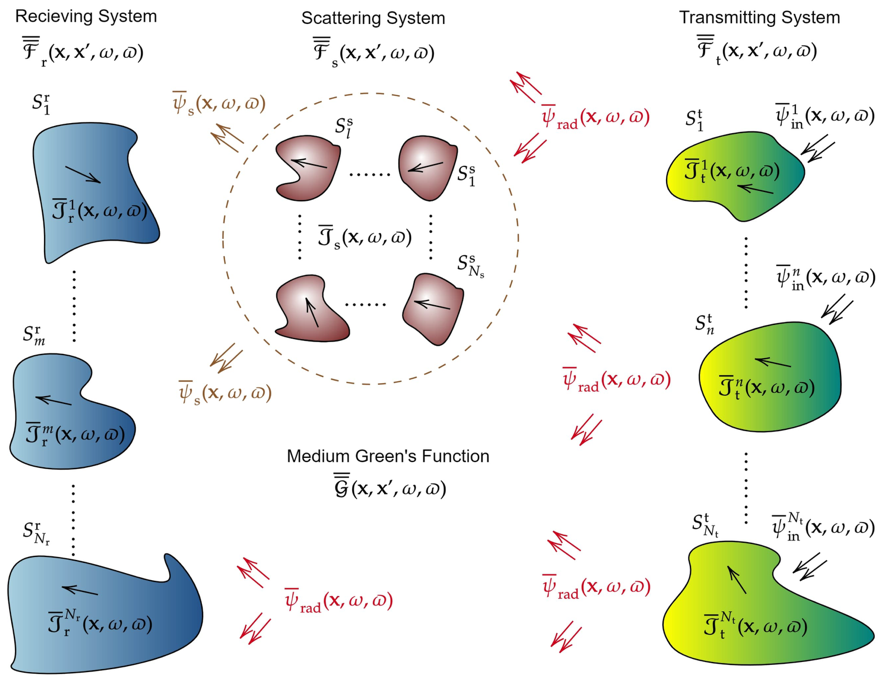
A Random Field Theory of Electromagnetic Information lays the foundational theoretical framework by developing an Electromagnetic Random Field Theory (EM-RFT) for information transmission. Unlike traditional approaches that treat the channel as an isolated black box, this theory models the entire communication ecosystem as a unified physical system encompassing transmitters, propagation media, scatterers, and receivers. Using Green’s functions to rigorously characterize the input-output mappings between all system components, it provides a unified mathematical language for analyzing how electromagnetic fields encode, propagate, and transform information.
▲
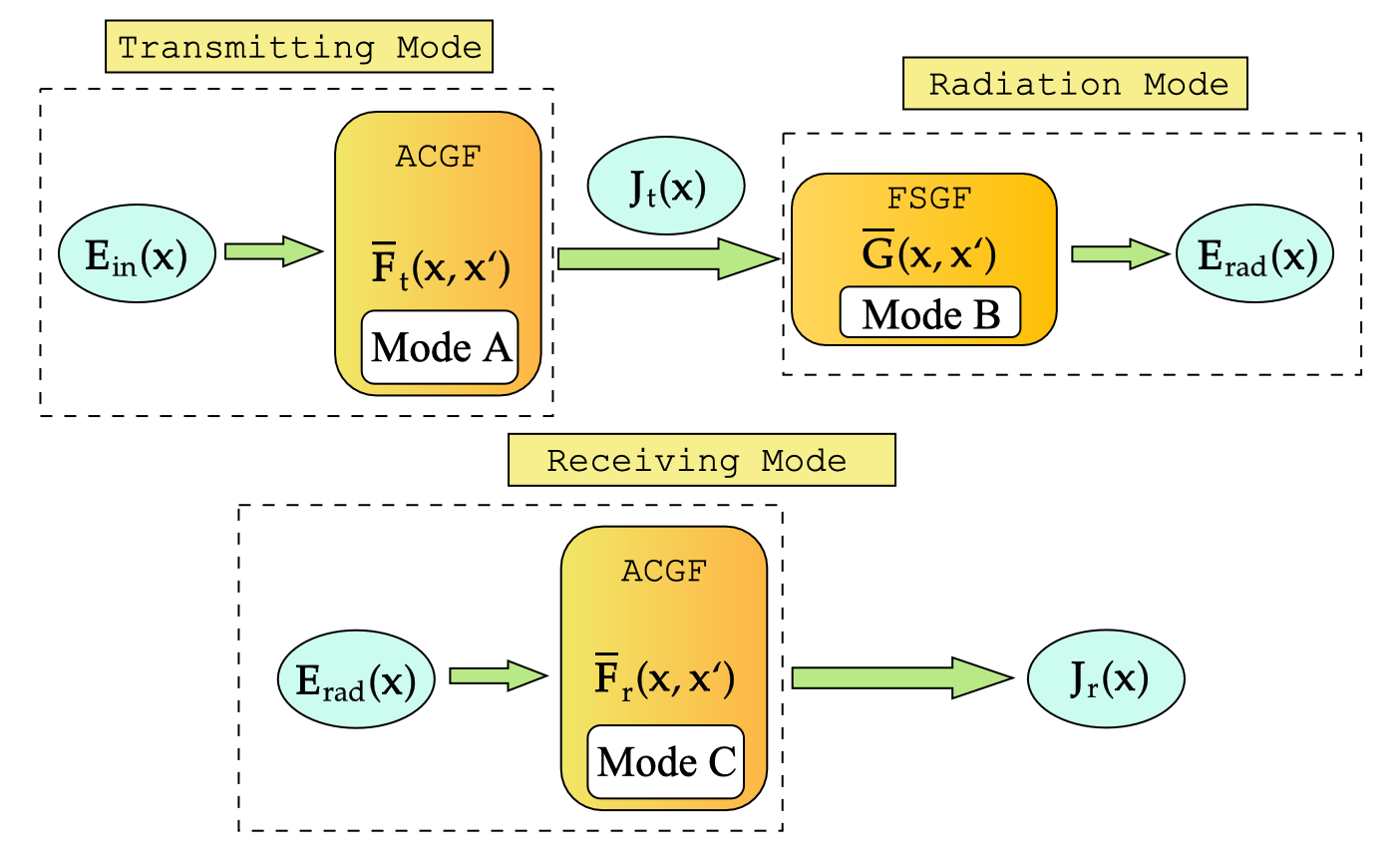
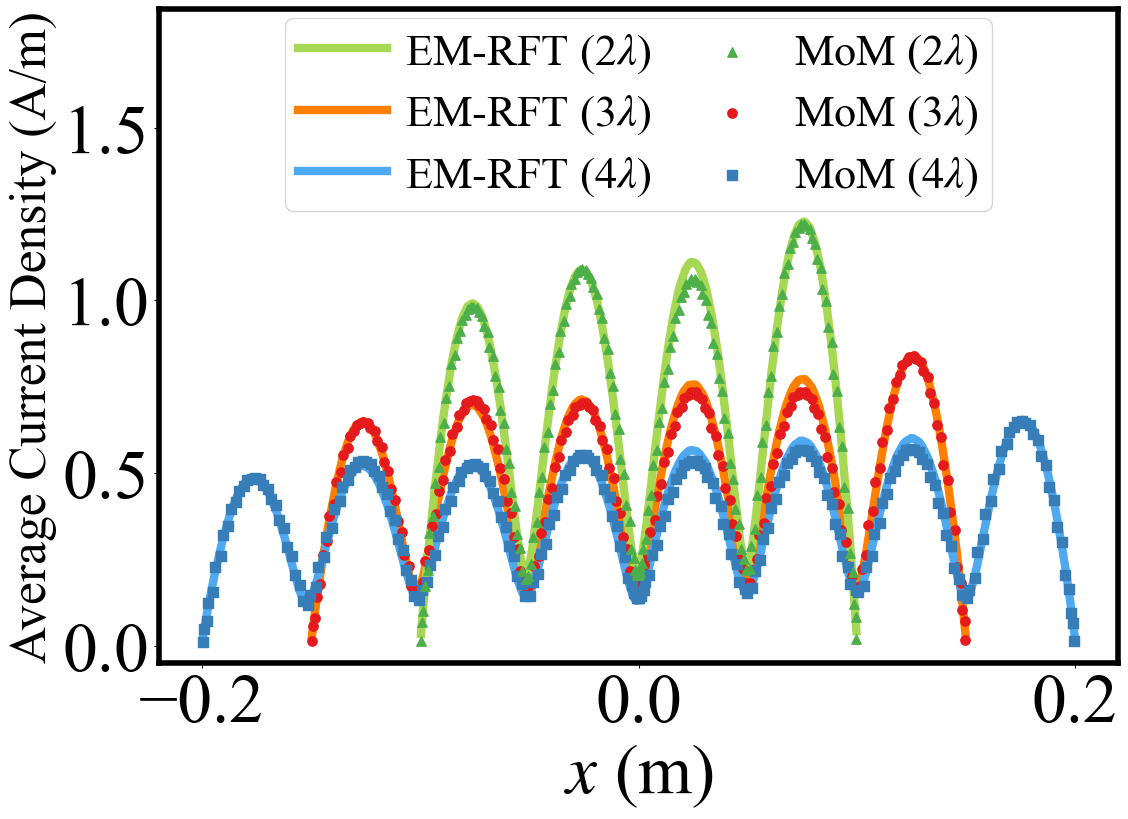
A Random Field-Theoretic Framework for Electromagnetic Information Computation bridges theory and practice by translating this abstract framework into a fully computable methodology. It introduces a rigorous computational approach rooted in exact Green’s functions that traces the complete signal flow chain: from incident fields and induced currents to radiation, free-space propagation, and reception. Using continuous MIMO systems, a core enabling technology for 6G, as a validation testbed, the team applies the Karhunen–Loève expansion to decompose random fields into orthogonal spatial modes, enabling physically consistent stochastic simulations that strictly adhere to Maxwell’s equations across arbitrary spatial domains.
▲
Notably, the simulations reveal a counterintuitive finding, even when the input random field follows a perfect Gaussian distribution, the output induced currents and radiated fields can exhibit strongly non-Gaussian and non-circular statistical characteristics after propagation, radiation, and mutual coupling. This fundamentally challenges the long-standing Gaussian channel assumption that underpins most conventional communication theory, highlighting the critical need for physics-based analytical tools for next-generation systems.