A research team led by Assistant Professor Kemal Celebi at the Zhejiang University–University of Illinois Urbana-Champaign Institute (ZJUI) has achieved a significant breakthrough in carbon-capture membrane research, with their latest findings published in Nature Communications. The paper's first author is Li Pingping, a 2022 doctoral student in Materials Science and Engineering at Zhejiang University. The corresponding author is Assistant Professor Kemal Celebi at Zhejiang University. Co-authors include Associate Professor Zhao Junjie from the College of Chemical and Biological Engineering at Zhejiang University, Associate Professor Donghun Kim from Chonnam National University in Korea, and Zhejiang University students Dai Xiangcheng, a 2024 doctoral student in Materials Science and Engineering, Muhammad Mohtashim Asif, a 2025 Master's Student in Energy and Power, Zhang Ming, a 2021 doctoral student in Chemical Engineering and Technology, and Hu Yubin, a 2023 doctoral student in Chemical Engineering and Technology.
▲
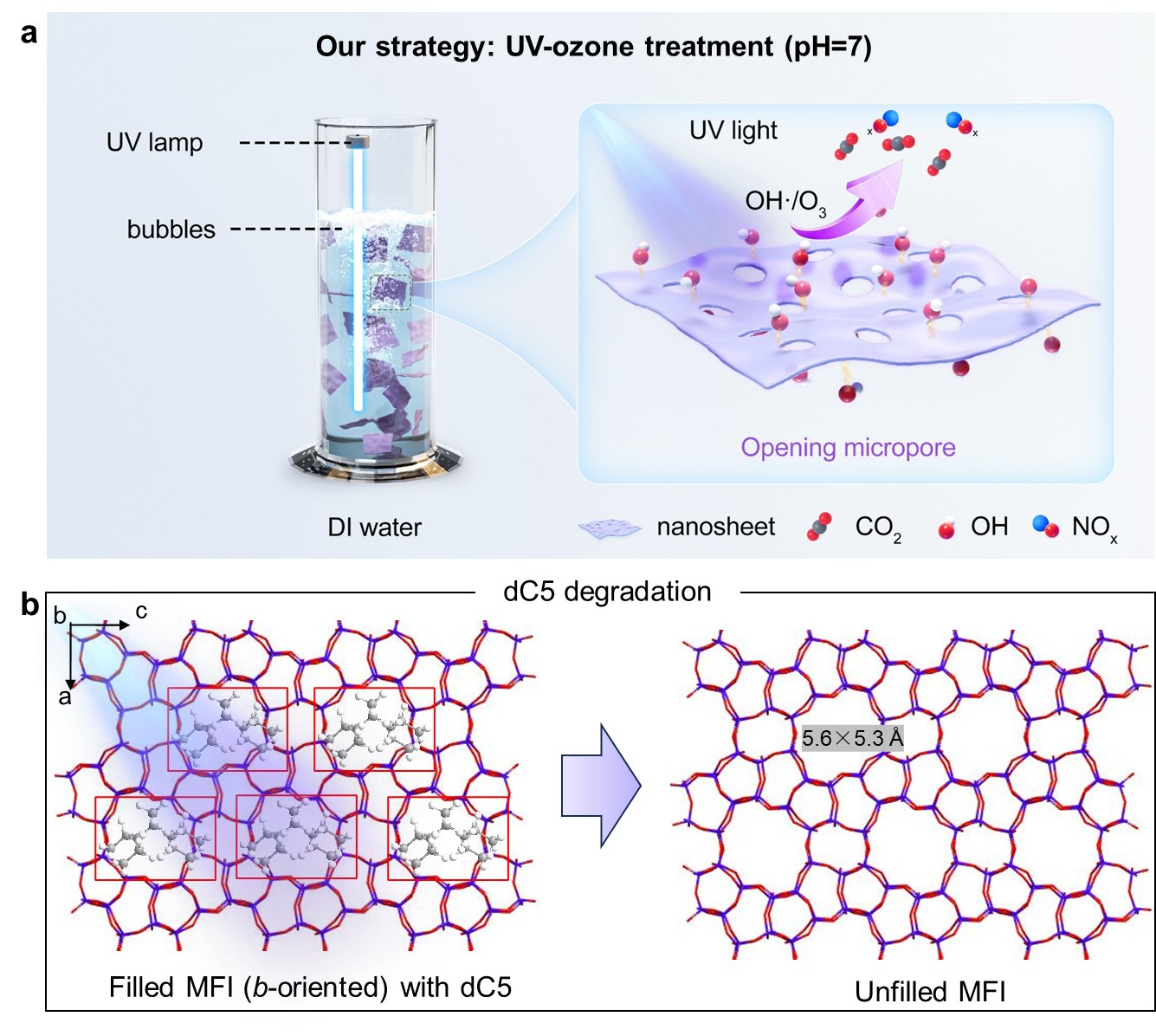
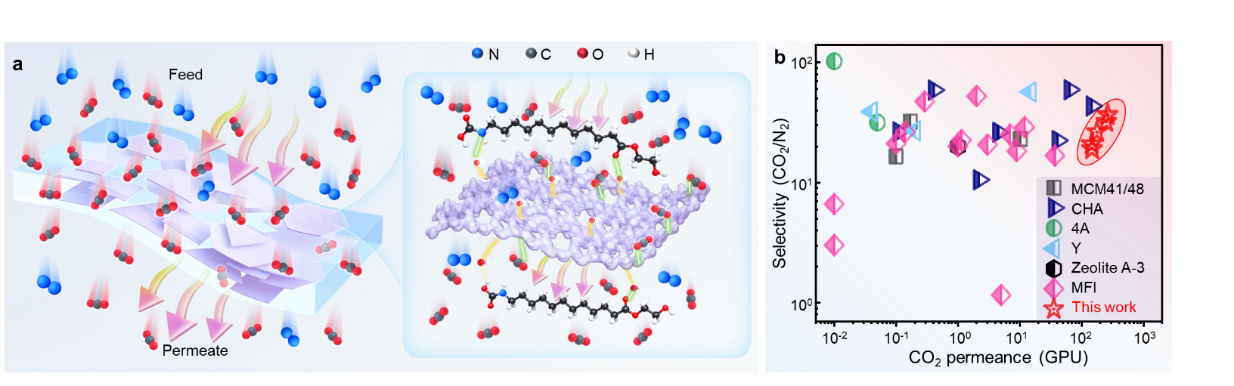
This study addresses a long-standing bottleneck in zeolite nanosheet processing: conventional high-temperature calcination required to remove organic structure-directing agents and open the micropores before membrane fabrication, causes irreversible aggregation of the nanosheets upon drying, severely limiting their dispersibility and membrane performance. To overcome this challenge, the team proposed for the first time an aqueous UV/O₃ liquid-phase activation strategy that gently removes organic templates while the nanosheets remain dispersed in solution, entirely preventing aggregation at its source. The UV-ozone treatment also functionalizes the nanosheet surfaces with hydroxyl groups, enhancing CO₂ adsorption affinity and improving interfacial compatibility with the polymer matrix. Building on this approach, the team fabricated an ultrathin, b-oriented MFI mixed-matrix membrane approximately 1 μm thick. Under ambient temperature and pressure, the membrane could achieve a CO₂/N₂ selectivity of 40±6 and a CO₂ permeance of 194±50 GPU at an optimal filler loading of 1.6 wt.%, significantly outperforming pure Pebax membranes and breaking the traditional permeance–selectivity trade-off of conventional thicker mixed-matrix membranes. This work provides a new and scalable route for the mild activation, stable dispersion, and thin-film fabrication of zeolite nanosheets, with broad implications for advancing low-energy, high-efficiency carbon-capture membrane technologies.
▲