In a recent research advance in the field of microphysics and engineering, a team led by Associate Professor Said Mikki at the Zhejiang University–University of Illinois Urbana-Champaign Institute (ZJUI) has published new findings in the internationally renowned journal Physical Review A. The paper's first author is ZJUI postdoctoral researcher Muhib Ullah, and the corresponding author is Associate Professor Said Mikki.
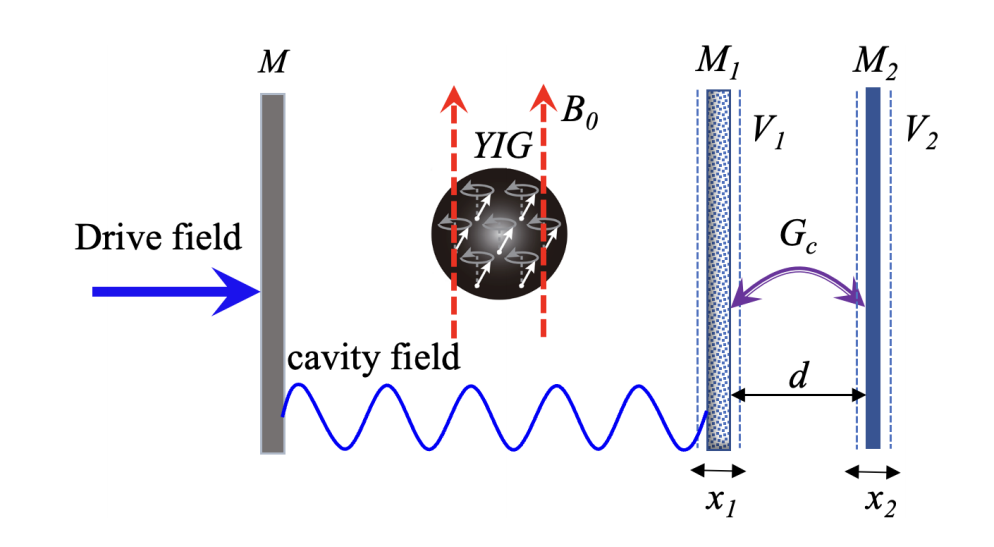
The research team proposes a novel theoretical framework for a hybrid cavity optomechanical magnonic system. In this scheme, a yttrium iron garnet (YIG) sphere is embedded in an optomechanical cavity to enable magnetodipole coupling between cavity photons and magnons. At the same time, cavity photons interact with a mechanical resonator via radiation pressure, while two oppositely charged mechanical resonators are coupled through electrostatic Coulomb interaction. This design brings photonic, magnonic, and phononic modes into a unified framework for studying correlated states across different physical modes.
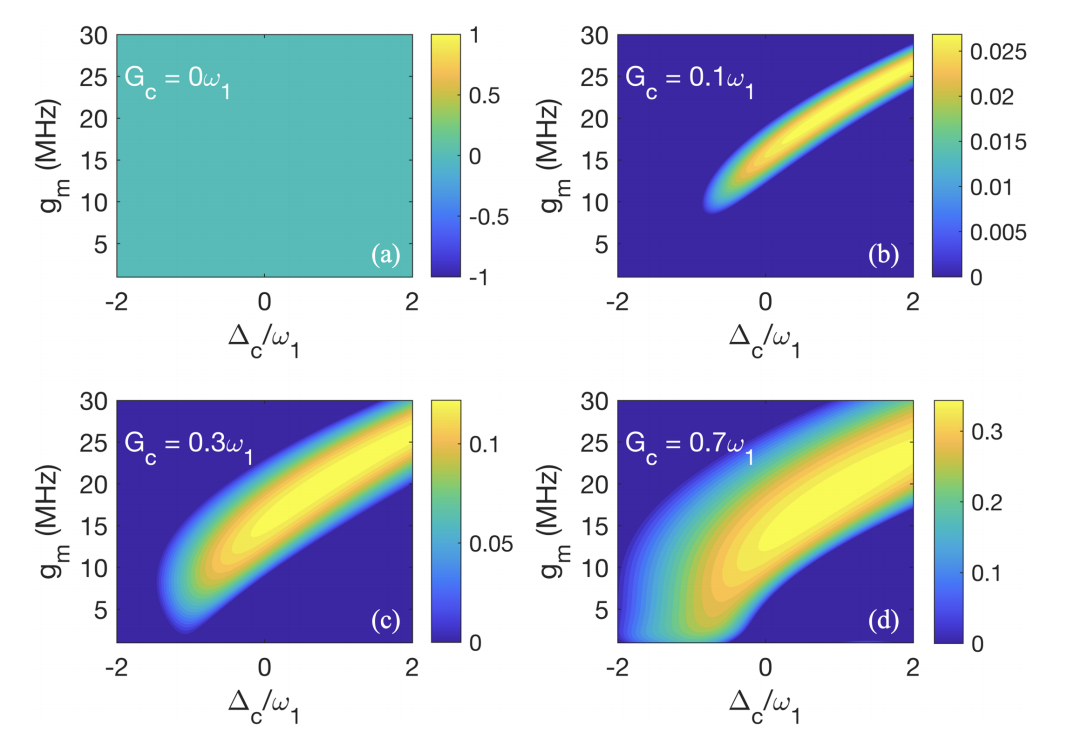
The study investigates how the magnon nonlinear Kerr effect, together with magnetodipole, optomechanical, and Coulomb couplings, influences the evolution of entanglement in the system. Numerical results show that Coulomb coupling is crucial for generating entanglement between the two mechanical resonators: without it, the entanglement is nearly absent, whereas stronger Coulomb coupling raises the entanglement strength to about 0.3 and broadens the parameter range over which robust entanglement can be maintained. The study also shows that stronger optomechanical and Coulomb couplings improve thermal robustness, allowing the entanglement to persist at 2.8 K, consistent with the paper’s conclusion that the system remains resilient at around 3 K.
In addition, the work examines photon-phonon entanglement between cavity photons and the mechanical resonator, showing that magnon Kerr nonlinearity plays an important role here as well: larger Kerr-induced frequency shifts lead to stronger photon-phonon entanglement, especially under stronger optomechanical coupling. The authors further note that the proposed system is compatible with existing experimental capabilities, including strong photon-magnon coupling in YIG systems, electrostatic tuning between resonators, and low-temperature suppression of thermal noise. Overall, the study provides a practical theoretical framework for future research on entanglement control in hybrid systems, with potential applications in continuous-variable information processing, including memory, networking, and transduction.