Recently, the research team led by Assoc. Prof. Said Mikki of Zhejiang University-University of Illinois Urbana-Champaign Institute (ZJUI) has made two significant research advances, with their findings published in Institute of Electrical and Electronics Engineers (IEEE) Transactions on Communications and IEEE Antennas and Wireless Propagation Letters. The first author of both papers is Hu Jiarun, a 2023 doctoral student in Electronic Science and Technology at Zhejiang University, and the sole corresponding author is Assoc. Prof. Said Mikki.
Neural Network Realizations of Wideband Near-Field Communication Systems: An Electromagnetic Design Approach
Journal: IEEE Transactions on Communications
The findings on broadband near-field communication system design were published in IEEE Transactions on Communications. The first author is Hu Jiarun and the second author is postdoctoral research fellow Thng Guo Hao at Zhejiang University.
In the area of broadband near-field communications, the team addressed a core challenge, namely performance degradation caused by the strong frequency dependence of near-field focusing. To overcome this limitation, they proposed a broadband near-field beam focusing framework that integrates first-principles electromagnetic physics with neural networks.
As 6G technologies continue to evolve, large-scale antenna arrays are widely recognized as a key enabler for higher data rates, improved energy efficiency, and enhanced user experience. Unlike conventional far-field communications based on plane-wave propagation, 6G systems increasingly operate in the near-field (Fresnel region), where electromagnetic waves exhibit spherical-wave behavior. This enables precise three-dimensional energy focusing and introduces new degrees of freedom for communications, sensing, and wireless power transfer. However, near-field array responses are inherently strongly frequency dependent, causing traditional precoding methods to suffer from focal splitting. In addition, channel models based on scalar Green’s functions neglect full-wave effects and polarization coupling, fundamentally limiting focusing accuracy in practical systems.
▲
▲
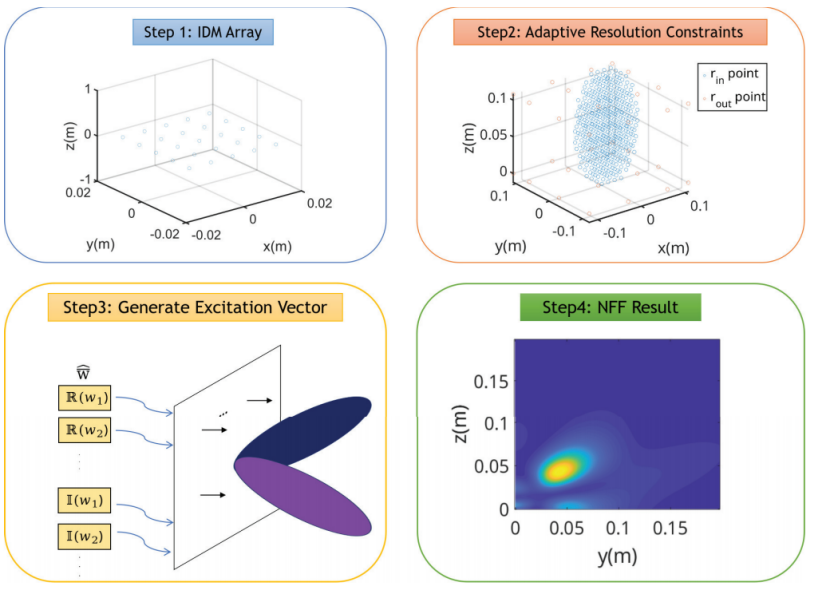
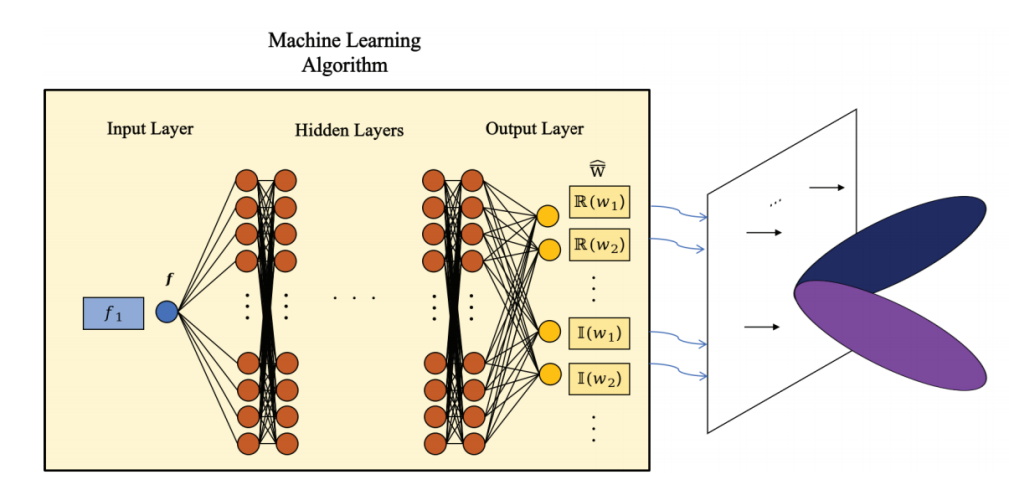
To address these issues, the team looked for the underlying physics and developed a new near-field focusing framework consisting of three key components. First, an infinitesimal dipole model combined with dyadic Green’s functions was employed to achieve high-fidelity three-dimensional polarized near-field modeling. Second, the single-frequency near-field focusing problem was reformulated as a semidefinite convex optimization problem, producing physically interpretable optimal excitation data for neural network training. Third, a multilayer perceptron neural network was constructed to learn the mapping between frequency and optimal excitation, enabling broadband generalization and real-time inference on the millisecond timescale.
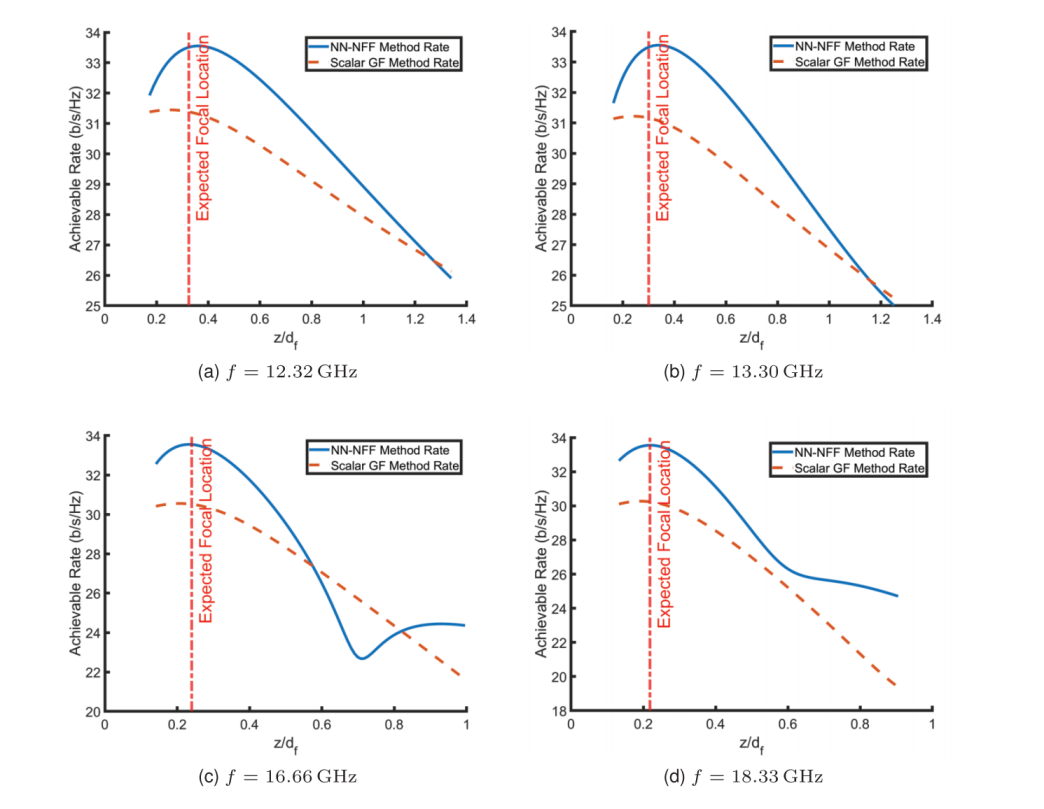
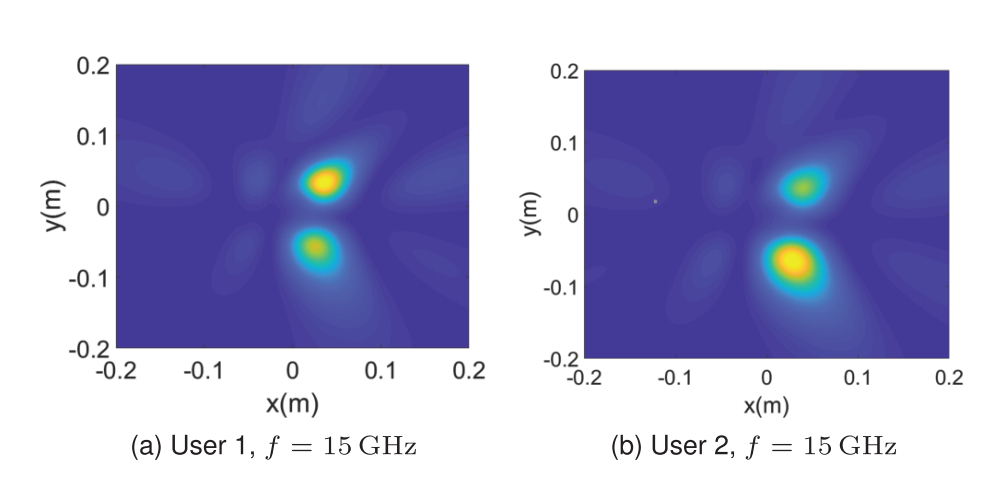
Simulation results demonstrate that the proposed approach significantly outperforms conventional methods. In single-user, single-frequency scenarios, the achievable rate improves by approximately 7.5 percent compared with scalar-model-based approaches. In broadband scenarios, focal splitting is effectively suppressed, resulting in a 56 percent increase in achievable user rates. At the same time, neural network inference is more than five orders of magnitude faster than convex optimization, fully meeting real-time communication requirements. The framework can also be extended to multi-user scenarios by training user-specific subnetworks, thereby mitigating interference and increasing overall system capacity.
▲
▲
By tightly integrating deep neural networks with first-principles electromagnetic modeling, this work introduces a new paradigm for broadband near-field communication system design. It achieves high-precision and real-time near-field focusing while demonstrating the potential of neural networks to accelerate physics-based optimization, providing valuable insights for intelligent 6G and future wireless systems.
Multifrequency Near-Field Focusing Through Infinitesimal Dipole Models and Neural Networks
Journal: IEEE Antennas and Wireless Propagation Letters
In a related study on multifrequency near-field focusing, the team proposed a method that combines infinitesimal dipole representations with neural networks, successfully addressing near-field focusing in realistic antenna arrays under strong mutual coupling conditions. This work was published in IEEE Antennas and Wireless Propagation Letters, with Hu Jiarun serving as the first author.
Near-field beam focusing is a critical capability for both 6G communications and wireless power transfer, yet practical antenna arrays face two major bottlenecks. First, strong inter-element mutual coupling fundamentally alters radiation characteristics, which cannot be accurately captured by conventional scalar Green’s function models, leading to severe performance degradation in real arrays. Second, the frequency dependence of array responses causes focal splitting in broadband operation, while full-wave optimization methods, although accurate, incur prohibitive computational costs for real-time applications.
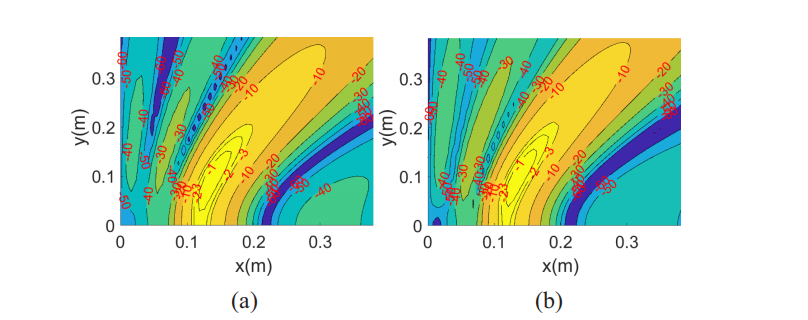
To overcome these challenges, the research team began with active element radiation patterns and incorporated surface current distributions computed using the method of moments. This approach enabled the construction of an equivalent infinitesimal dipole model for each array element that explicitly accounts for mutual coupling effects. The proposed model reproduces the near-field radiation characteristics of real arrays with exceptionally high accuracy, achieving errors as low as minus 25.26 decibels relative to full-wave simulations. This provides a reliable physical foundation for multifrequency focusing optimization. On this basis, the single-frequency focusing problem was formulated as a semidefinite convex optimization problem, generating high-quality and physics-consistent training data.
▲
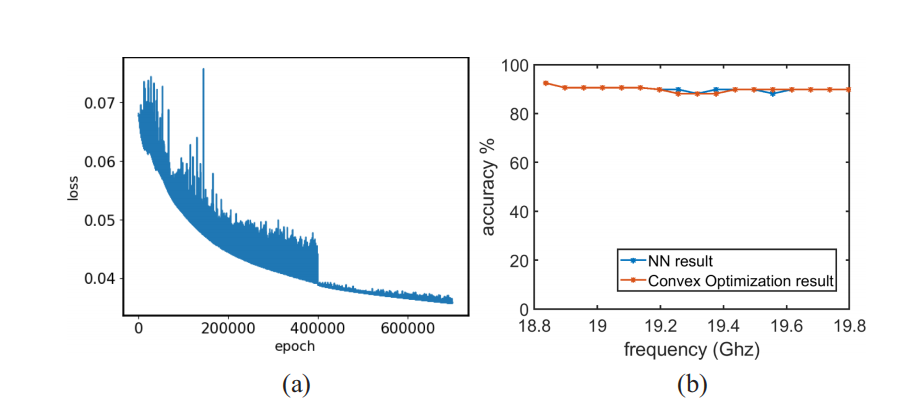
By learning the mapping between frequency and optimal array excitation, the trained neural network can accurately predict optimal excitations at arbitrary frequencies within milliseconds, enabling fast multifrequency near-field focusing. Simulation results show that for a 10-element half-wavelength dipole linear array operating over the 18.8 to 19.8 gigahertz band, the system maintains over 90 percent focusing accuracy across the entire frequency range. In terms of computational efficiency, the single-frequency excitation prediction time is reduced from 46.3 seconds using conventional convex optimization to approximately 2.4 milliseconds, representing a speedup of more than four orders of magnitude.
▲
Overall, this study represents the first systematic integration of accurate mutual coupling modeling into a data-driven near-field focusing framework. By leveraging neural networks for efficient learning and real-time inference of complex electromagnetic behavior, it establishes a new pathway for multifrequency and broadband near-field focusing that balances engineering practicality with physical accuracy and effectively bridges the gap between idealized models and real-world antenna array applications.